The Periyar Boat: You Are Booking a Sailing Time, Not a Boat Ride
Thekkady's lake cruise is sold partly online and partly at a counter that queues before dawn, every ticket carries your ID, and the sailing you get decides what you see. Here is how the booking actually works, which slot is worth the early start, and what the boat will and will not show you.
Almost everybody who stops in Thekkady does the same thing: a boat on Periyar lake. It is the one experience the town is built around, and on paper it could not be simpler. An hour and a half on the water, inside a tiger reserve, for less than the price of a decent lunch.
In practice it is the single most mishandled booking in Kerala. Not because it is expensive or hard to find, but because of a detail nobody mentions until you are standing in a queue at six in the morning. You are not booking a boat ride. You are booking one specific sailing, out of a handful that run each day, and they are nothing like each other.
The first sailing after sunrise gives you mist on the water and animals still out on the banks. The middle-of-the-day sailings give you heat, glare and an empty shoreline. Same lake, same boat, same ticket. Completely different morning.
On top of that, only part of each sailing is sold online. The rest goes at a counter near the park gate, which is why that queue forms before the counter opens. And every ticket is issued against a named ID, so you cannot buy four and bring whoever turns up.
This guide sticks to what the forest department publishes and what our own drivers in Kumily deal with every week. Where a number is only floating around on travel blogs, we say so rather than printing it as fact.
What you are actually getting on the water
Worth understanding, because it explains why this ride works at all.
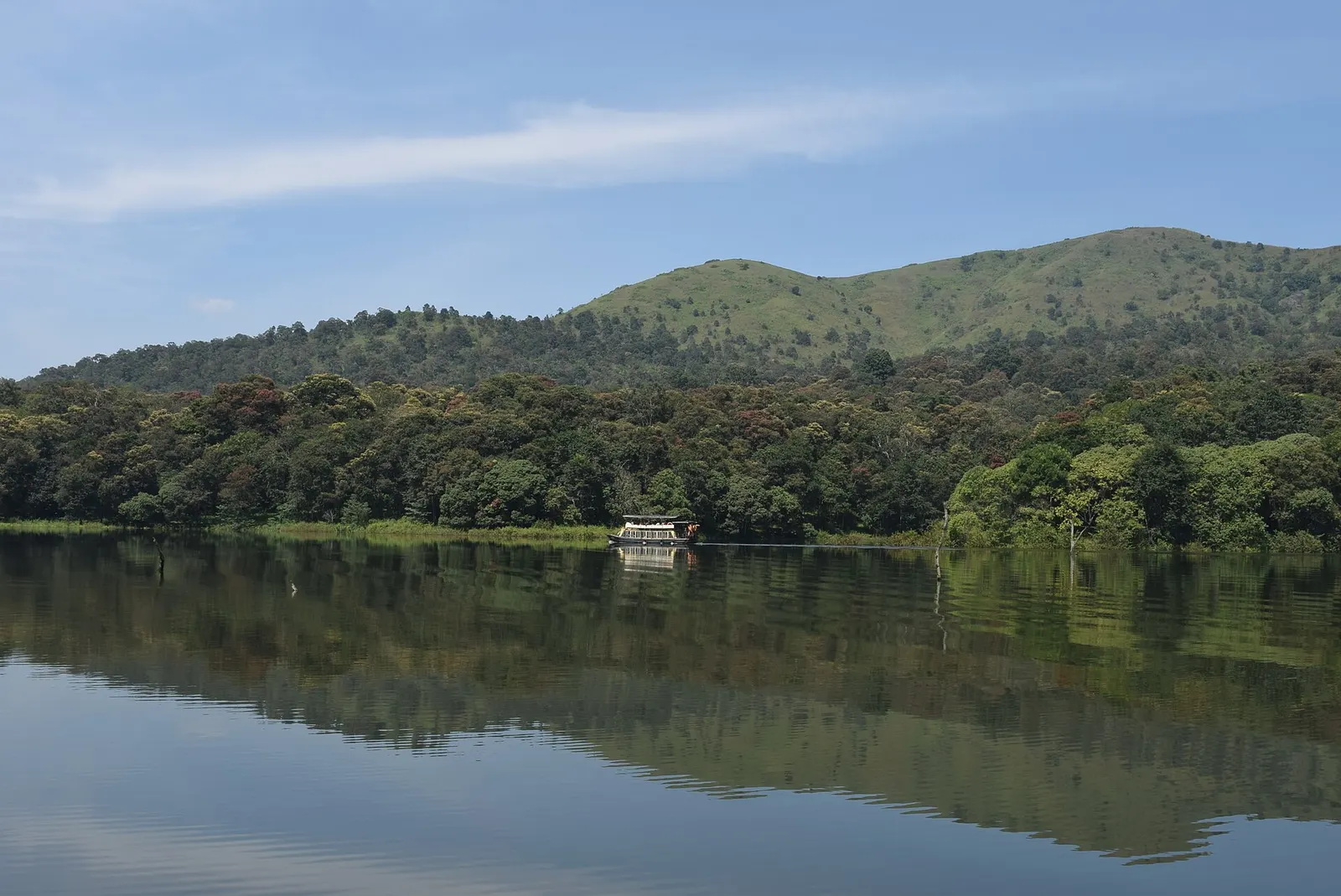
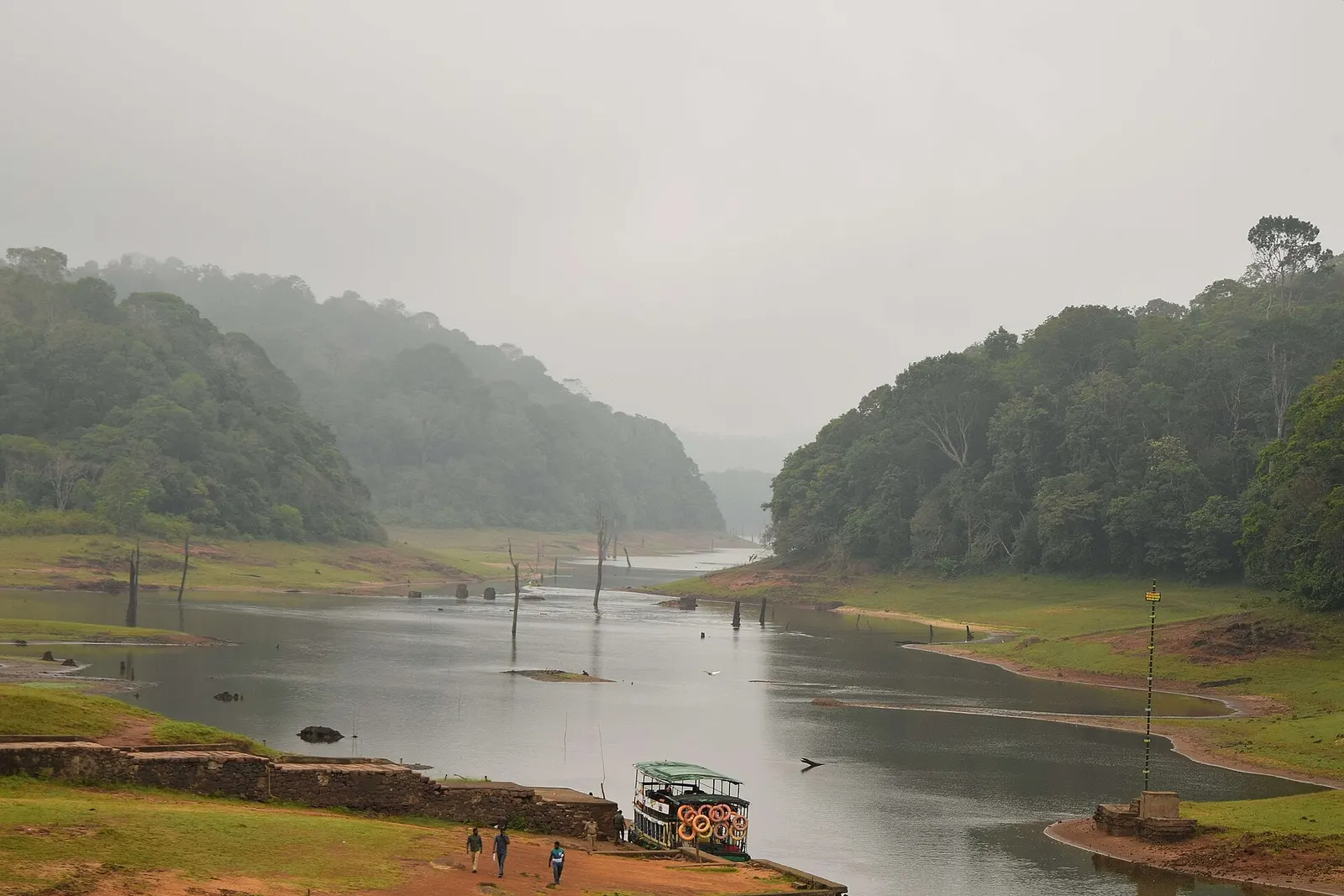
Periyar lake is not a natural lake. It is a reservoir of roughly 31 square kilometres, formed when the Mullaperiyar Dam was built in 1895 and the valley behind it filled. The forest that was standing there drowned, which is why the water is full of pale dead trunks sticking out of it, and why the shoreline is a long, shallow, grassy edge rather than a bank.
That accidental shape is the whole reason the boat is worth doing. Animals in the surrounding forest come down to a drinkable, grazable edge, and a boat moving across open water does not spook them the way a vehicle on a track does. You are not chasing wildlife. You are drifting past the place it comes to anyway.
The lake sits inside Periyar Tiger Reserve, about 925 square kilometres in total, with a national park core of roughly 350 square kilometres notified in 1982. It was declared a tiger reserve in 1978, and before that it was a sanctuary from 1950, and before that a private reserve declared in 1934 by the Maharaja of Travancore to stop tea plantations eating into the forest around the lake. Thekkady is about 4 km from Kumily, the town you will actually be staying in.
The sailings are not equivalent, and this is the real decision
The forest department runs several sailings across the day, the first shortly after the park opens and the last in the late afternoon. The exact times and the exact number of trips shift with the season and with water levels, so treat the official booking portal as the only timetable worth trusting on the day you travel.
What does not shift is the pattern of what each slot gives you. This is the part no timetable tells you.
| Sailing | What it is like | Worth the effort? |
|---|---|---|
| First, just after opening | Mist on the water, cool air, animals still out on the banks after the night | Yes. This is the one to aim for |
| Second, mid-morning | Light is good, shoreline emptying out, boats busier | A solid second choice |
| Midday | Hot, hard overhead light, very little moving on the banks | Take it if nothing else is left |
| Early afternoon | Still hot, haze on the hills, quieter on the water | The weakest slot of the day |
| Last, late afternoon | Animals coming back down to drink, warm light, popular | The best alternative to the first |
Why the ticket is harder than the price suggests
The boat is cheap. Getting a seat on the sailing you want is not, and that is down to three things stacked on top of each other.
The boats have a hard capacity. Each sailing seats a fixed number and the forest department does not flex it. There is a sober reason for that, which we come back to below.
Only a share of each sailing is sold online. The forest department has run online boating tickets through its own portal since 2014, and the rest of each sailing is held back for the counter at the park. How big that online share is depends on who you ask: the figures repeated across travel sites contradict each other, so we are not going to publish one. What matters is the consequence, which nobody disputes. If the online allocation for the first sailing is gone, there may still be counter tickets, and the counter opens early and clears fast in season.
Tickets are tied to a named ID. You enter an ID at the time of booking and you carry that same original document to the boat landing. A passport, driving licence, Aadhaar, voter ID, PAN or another government ID works for Indian nationals, and foreign nationals use a passport. This is not a formality anybody waves through.
Put those together and the honest summary is this. Book the sailing you want online, as early as you reasonably can, through the official Periyar Tiger Reserve booking portal. If your slot is sold out online, you are not out of options, but you are now in the queue, and the queue is a 6 am problem rather than a 9 am one.
A diagram showing each Periyar sailing split between an online allocation on the forest department portal and counter tickets bought at the park, with a fixed seat capacity on every boat.
Why the capacity is fixed, and why nobody bends it
This is worth knowing, briefly, because it is the reason the boat is scarce rather than merely busy.
On 30 September 2009, a double-decker tourist boat called the Jalakanyaka capsized on this lake. Of the 82 people aboard, 45 died. The boat was carrying 12 more people than its capacity of 75, and life jackets had not been issued to passengers. It remains the deadliest boat accident in Kerala's history.
In the days afterwards the state announced mandatory safety checks on tourist boats, compulsory life jackets, and lifeguards and rescue boats in proportion to passenger numbers. Those measures are why your sailing has a seat count that is not negotiable, why you will be handed a life jacket and asked to wear it, and why staff move people off a rail if everyone drifts to one side to look at something.
None of this is a reason to hesitate. It is a reason to be patient with the queue, wear the jacket without arguing, and stay seated when a herd appears on the bank.
Getting to the water is its own small puzzle
The boat landing is not where your car stops, and people lose their sailing to this more often than to the booking.
Vehicles stop at the car park at Aanavachal, near the park entrance. From there a forest department shuttle bus runs the last stretch down to the boat landing, and it is the only way to cover it. The ride takes a few minutes but the waiting does not, especially when three sailings' worth of people arrive at once.
So the working rule is to be at the ticket counter area around 30 minutes before your sailing, with the original ID you booked against in your hand and not in a bag in the boot. If you are cutting it finer than that, you are gambling on the shuttle.
There is no ride-hailing in Kumily or Thekkady. Autos exist and will take you to the gate, but getting one back at the end of a sailing, or getting one to wait, is a negotiation rather than a service. This matters less for the boat itself than for everything you want to do afterwards.
What the boat will and will not show you
Expectations are where this experience most often disappoints, and it is almost always because somebody arrived hoping for a tiger.
The reserve records about 35 species of mammals and 266 species of birds, and a tiger survey across the reserve in 2017 counted around 40 tigers across 925 square kilometres. Do the arithmetic on that density and then imagine seeing one from a boat on a fixed route at a fixed time. It happens. It is not a reasonable thing to plan a morning around.
What you can reasonably hope for on an early or late sailing is elephants at the water's edge, gaur, sambar, wild boar, otters, and a lot of birds including hornbills, kingfishers and darters on the dead trees. Some sailings deliver all of that in ninety minutes. Some deliver a beautiful empty lake and a single distant deer. Both are normal, and the boat is worth doing either way.
A pair of binoculars changes this trip more than any other piece of gear. The boat keeps its distance from the bank by design, and your phone camera will not close that gap.
This is the same honesty problem we wrote about for Kaziranga and Gir. A permit buys you access to a habitat, not a sighting, and the operators who imply otherwise are the ones you should trust least.
When to go, and what the season actually changes
The window is open now. October to March is the straightforward answer for both the boat and the hills around it, and the northeast monsoon that runs roughly October to December is part of that window rather than a reason to avoid it.
Temperatures in the reserve sit between about 15 degrees in December and January and about 31 degrees in April and May, and annual rainfall is in the 2,000 to 3,000 mm range, around two thirds of it in the southwest monsoon from June to September.
What the season changes is what the shoreline looks like. In the dry months the water drops, the grassy edge widens, and animals have fewer places to drink, which concentrates them where the boat can see them. In the southwest monsoon everything is green and beautiful and spread out, so there is less reason for anything to come to the lake. The boat still runs and the hills are at their best, but the wildlife odds are genuinely lower, and anyone telling you otherwise is selling something.
If you are planning a wider route, our season-by-season guide to travelling in India covers how this window lines up with the rest of the country.
The programmes most visitors never hear about
Periyar runs one of the broadest sets of ecotourism programmes of any Indian reserve, and the boat is simply the one with the most seats. Nearly all of the others are small-group, guided by people from the villages around the reserve, and bookable through the same official portal.
They are worth knowing about for one practical reason beyond the experience itself. If the sailing you wanted is sold out, one of these may be a better use of the morning than a midday boat.
- Bamboo rafting. A full day combining a long walk through the forest with hours on the water on bamboo rafts, with guides from the local communities. The most physically involved of the regular programmes.
- Border hiking. A long guided trek along the reserve's edges, well away from the boat route and the crowds.
- Jungle scout. A night programme in which you walk a stretch of the reserve after dark with armed forest guards, in the hours when almost nobody else is inside the park.
- Periyar Tiger Trail. A multi-day wilderness expedition with camping inside the reserve, famously guided in part by men who once poached in it and now protect it. Limited slots and booked well ahead.
- Nature walks and short guided treks. The easiest substitute if the boat is full and you have half a morning.
Two days in Thekkady, not one afternoon
Most itineraries give Thekkady a single night, do the boat, buy cardamom and leave. That works, but it wastes the position. Kumily sits on the Tamil Nadu border in the middle of cardamom country, within reach of two completely different days.
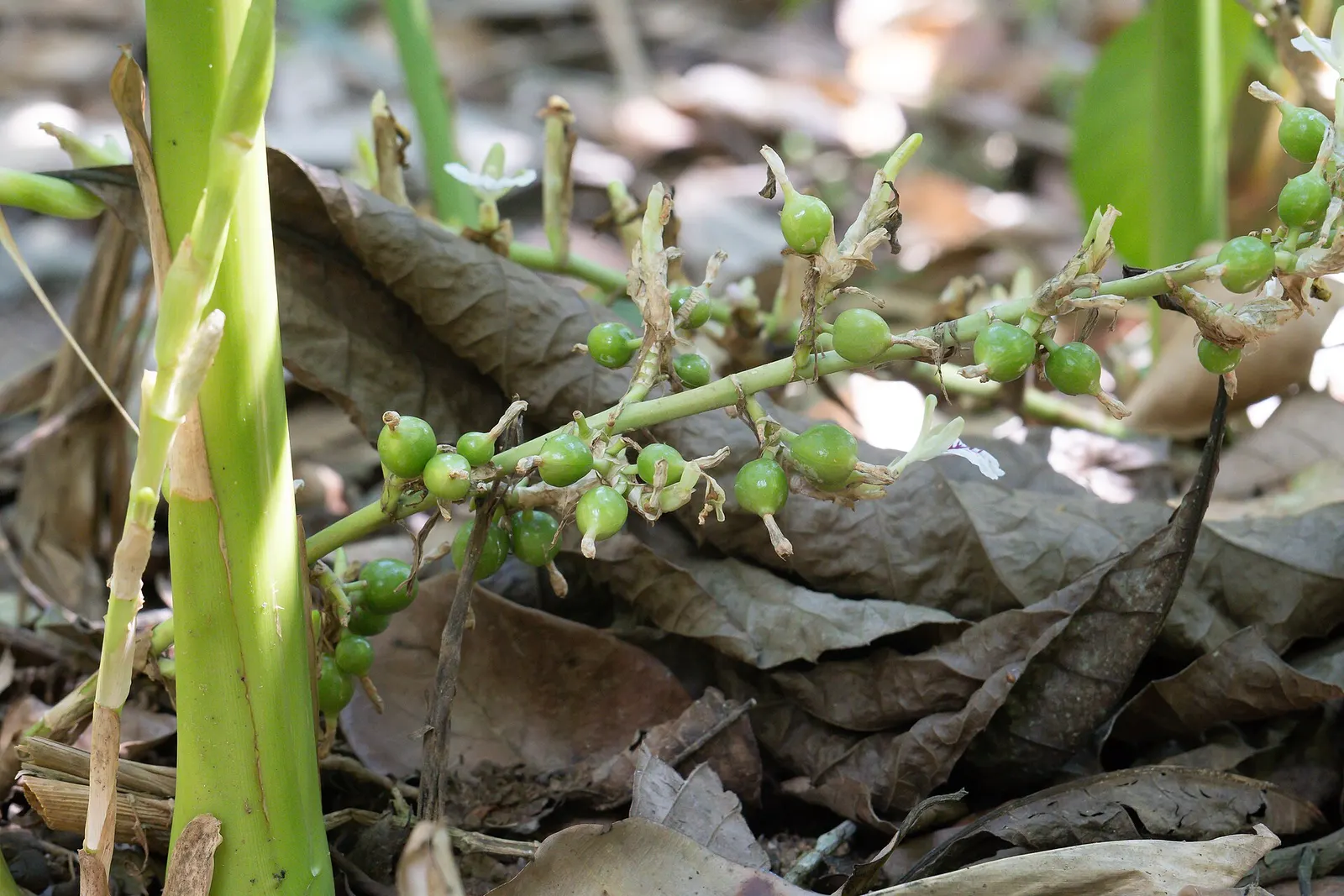
Day one is the lake and the spice hills. The early sailing, then a spice farm walk where cardamom, pepper, coffee, nutmeg and vanilla are all growing together under shade, then the drop at Chellarkovil where the cardamom hills end and the land falls away to the plains of Tamil Nadu, then Kumily's spice street on the way back.
Day two goes north over the Peermade hills to Vagamon, about 70 km away, which is pine forest, open meadows, the rock viewpoint at Parunthumpara and the climb at Kurisumala. It looks nothing like Thekkady and almost nobody staying in Kumily realises it is a day trip.
Thekkady also pairs naturally with Munnar, about three hours away by road, where the bottleneck is a different kind of ticket entirely. If that is your route, our guide to Eravikulam's tickets and timings covers the one booking that catches people out there. And if you are continuing to the backwaters, the houseboat decision is the next one worth getting right.
Doing it yourself, or booking the day
The boat itself you should book yourself, directly on the forest department's portal. Nobody needs an intermediary for that and anybody charging you a premium to do it is charging you for a web form.
The part that is genuinely awkward is the rest of the day around it. A 6 am start to make the first sailing, no ride-hailing in town, a shuttle you cannot skip, and then a set of stops spread over 50 km of back roads where an auto will drop you but will not wait. That is four separate arrangements for one morning, which is exactly the gap we wrote about in why booking travel experiences in India is still hard.
On GoExplorer, both Thekkady days exist as bookable experiences with a private car and a driver who waits, priced for the vehicle rather than per seat. The Periyar lake boat, spice farm and Chellarkovil day puts a car at your door at half past six so you are near the front of the counter queue, and moves the rest of the day around whichever sailing you get. The Vagamon pine forest and meadows day handles the two hours of ghat road each way. Both sit on the Thekkady page with how to get there and the best months. The boat ticket and the shuttle stay yours to buy, because they have to carry your ID.
If you would rather travel with a group, upcoming group trips and our itineraries are the place to look, and the full set of bookable experiences covers the other destinations where the same logistics problem applies.
The short version
You are booking a sailing, not a boat ride. The first sailing of the day and the last are a different experience from the three in between, and they are the two worth planning around.
Part of each sailing is sold online through the official forest department portal and part at the counter at the park, which queues before it opens in season. Every ticket carries a named ID and you must bring that original document.
No vehicle reaches the boat landing. Cars stop at the Aanavachal car park and a forest department shuttle covers the last stretch, so be at the counter area about half an hour before your sailing.
October to March is the window and the dry months concentrate animals at the water's edge. Expect elephants, gaur, sambar and a lot of birds. Do not plan a morning around a tiger.
If the sailing you wanted is gone, bamboo rafting, border hiking or a guided trek is a better morning than a midday boat.