Kaziranga Safari Booking: The Permit and the Jeep Are Two Separate Purchases
Kaziranga reopened on 3 October 2026 with two ranges running jeep safaris. Here is what the government portal actually sells you, why a confirmed permit does not come with a vehicle, which of the four ranges to pick, the two daily slots, and why October and December are different parks.
Kaziranga reopened for the 2026 to 2027 season on Saturday, 3 October, with the Assam Forest Minister marking it at the Kohora range. Jeep safaris started that morning. The rest of the park is coming back in stages, and elephant safaris are set to restart on 1 November.
Which means that for the next few weeks a lot of people will be booking a Kaziranga safari for the first time, and running into the same thing. You find the government portal, you pay, you get a confirmation, and you arrive in Assam with a valid permit and no vehicle. Nobody misled you. The permit and the jeep are genuinely two different purchases, from two different parties, paid at two different times. Almost no booking page says so on the page where you pay.
This guide is the part that gets left out: what the portal actually sells, who supplies the jeep, which of the four ranges is open and worth picking, the two daily entry slots, the fee structure and why published numbers disagree, and the one seasonal fact that decides how much you will see.
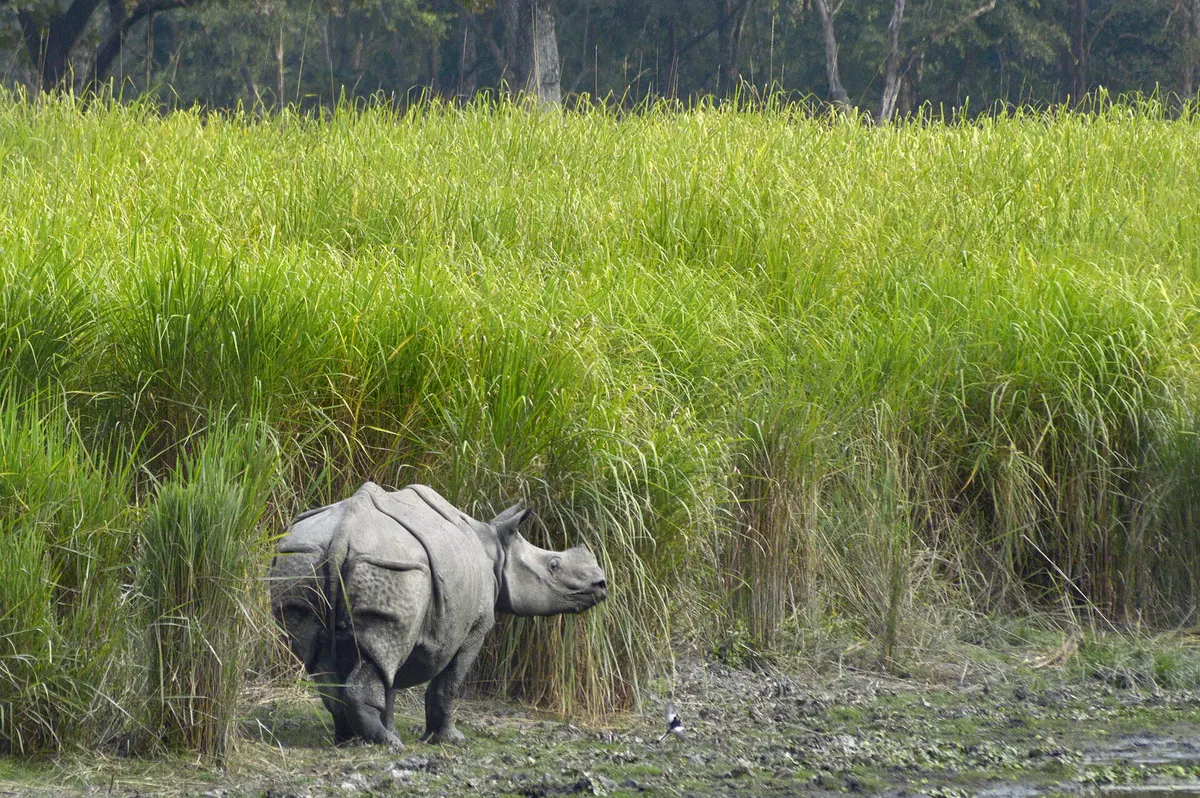
What reopened on 3 October, and what has not
Kaziranga closes every year for the monsoon, roughly late May to early October, because the Brahmaputra floods a large part of it. The reopening is a forest department order, not a fixed calendar date, so it moves by a few days from year to year. This season it was 3 October.
What is running now is narrower than the park as a whole, and that is normal for the first weeks:
- Jeep safaris are live in the Central (Kohora) and Western (Bagori) ranges. These are the two that opened on day one, and between them they carry most of the season's visitors.
- The Eastern (Agoratoli) and Burapahar ranges reopen in phases, by departmental order, after the first two. If you have your heart set on one of them, confirm it is open for your dates before you book anything else.
- Elephant safaris are not running in October. They are scheduled to restart on 1 November, with a small number of dawn seats at Kohora and Bagori, on a separate permit from the jeep.
- Pobitora Wildlife Sanctuary, the much smaller rhino sanctuary closer to Guwahati, was scheduled to reopen on 13 October. It is a useful fallback if Kaziranga dates do not work, though it is a different scale of place.
The thing nobody tells you: the permit is not the jeep
This is the single most useful thing to understand before you open a booking page.
The official route for a Kaziranga permit is the Assam government's Sewa Setu portal. You register with a mobile number, verify an OTP, find the Kaziranga safari booking service, pick a range and a date, enter the ID details of the people travelling, and pay. What arrives is a government ticket: park entry for named individuals, in a named range, in a named slot.
What does not arrive is a vehicle. The forest department issues the permit. It does not hire you a jeep. Inside Kaziranga only the park's registered safari jeeps run, each with a forest guide, and those are supplied by the local jeep associations and operators at Kohora and Bagori. That is a separate arrangement, paid on the ground, usually in cash.
So a Kaziranga safari is three transactions wearing one name: the government permit, the jeep hire with guide, and whatever got you from your hotel to the jeep point in the first place. People who book only the first one tend to find out about the second two at six in the morning.
The other reason this trips people up is that a large number of sites that look official are not. Several of the highest-ranking results for Kaziranga booking are private travel agencies with government-styled domain names, and at least two of them say so in their own disclaimers. Some are perfectly competent operators. None of them are the forest department. If you are paying what you think is a government fee, check that you are on the Assam government portal, and if you are paying an agency, know that you are paying an agency.
The four ranges, and which one to pick
Kaziranga's tourism zones are not interchangeable. They differ in landscape, in what you are likely to see, in how far they are from the usual stays, and in what the jeep costs.
| Range | Also called | Character | Status at reopening |
|---|---|---|---|
| Kohora | Central | Open grassland, beels and the highest traffic. The default, and the most reliable for rhino, wild buffalo and swamp deer. | Open from 3 October |
| Bagori | Western | About 20 km west of Kohora. Dense rhino country, a different landscape from the Central range, slightly quieter. | Open from 3 October |
| Agoratoli | Eastern | Wetland and birding country, further east. The range people go to for waterbirds rather than for a rhino count. | Phased, after the first two |
| Burapahar | Northern or Ghorakati | Hill and forest rather than grassland, furthest from Kohora, the least visited. | Phased, after the first two |
For a first visit with one or two safaris in hand, the answer is almost always Kohora in the morning and Bagori in the afternoon, or the reverse. They are open, they are close together, and they are where the open grassland is, which is what makes a rhino visible rather than theoretical.
Agoratoli is the better choice if you are a birder, and Burapahar if you want the fewest other vehicles and do not mind that the forest makes sightings harder. Both are further out, which changes the shape of the day, and both are later to open.
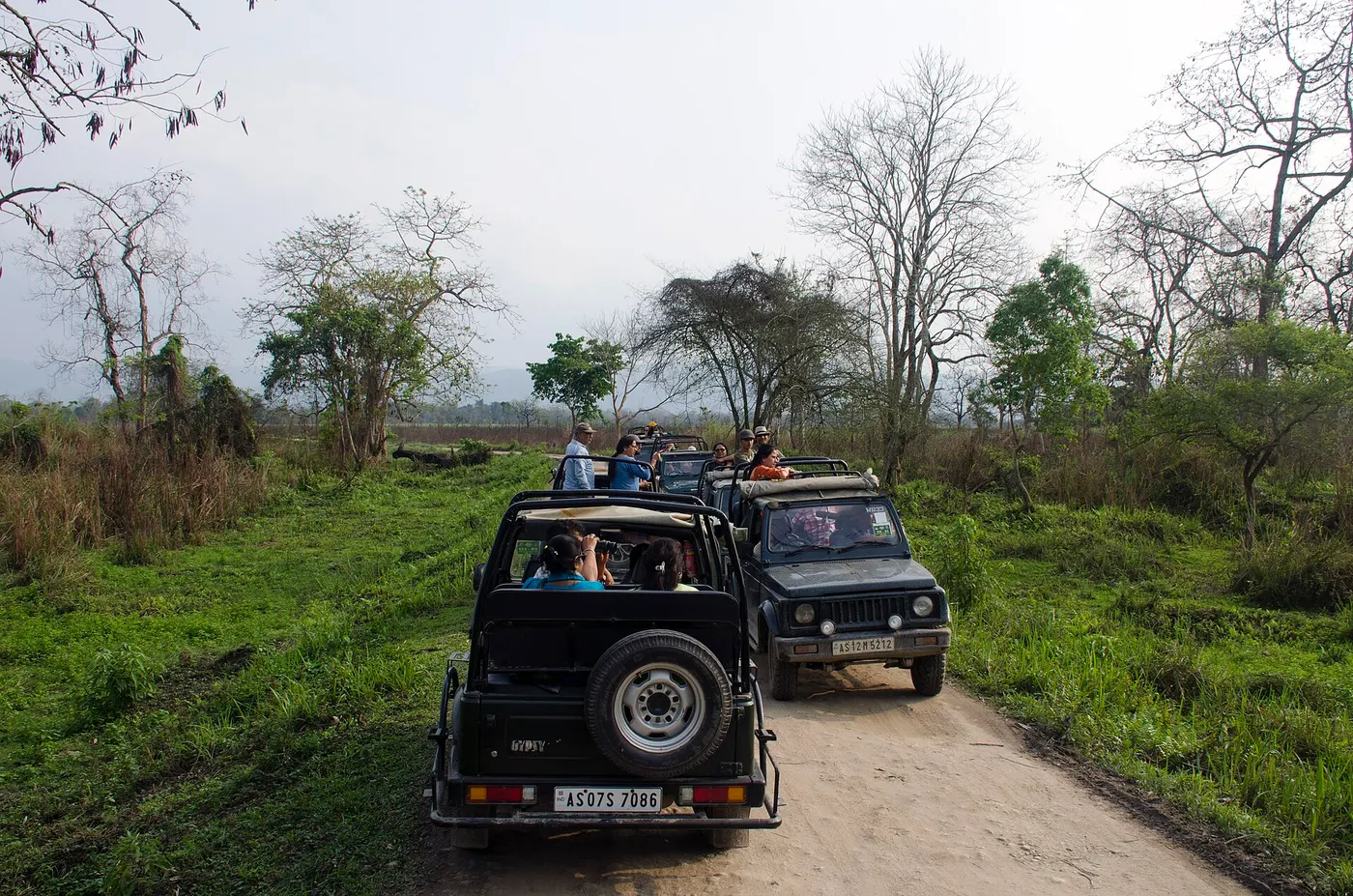
Two slots a day, and the ID gets checked
Jeep entry runs in two fixed windows, with exit cut-offs later. At the reopening these were a morning entry between 7:30 and 10:00 am and an afternoon entry between 1:30 and 3:00 pm. Published timings vary a little by range and shift slightly through the season as daylight changes, so treat these as the shape rather than the gospel and confirm for your date.
A few operational facts that matter more than they sound:
- A jeep seats six visitors, plus the driver and the forest guide. The hire is quoted for the vehicle, not per head, which is why a group of six pays very differently per person than a couple does.
- The permit is issued against ID and it is checked at the gate. Carry the original of whatever document you booked with. Foreign visitors book on passport details.
- Permits are non-refundable and non-transferable. You cannot hand a slot to someone else, and a late arrival is a missed slot.
- Morning is the better slot in almost every range, and it is the one that sells out. Animals move at first light, the grass is wet, and the park is quieter.
- Peak season needs real notice. December and January morning slots at Kohora and Bagori are commonly booked weeks ahead, and the first-light slots went early this year as the season opened.
What it costs, and why the numbers online disagree
If you search for Kaziranga safari charges you will find a dozen confident, mutually contradictory figures. That is not because everyone is lying. It is because the total is assembled from several components, charged by different parties, revised between seasons, and quoted differently depending on whether a site is listing the government fee, the jeep hire, or a packaged rate with its own margin on top.
The structure, which is stable even when the numbers are not, looks like this:
- A park entry fee per person, paid through the government portal, with separate Indian and foreign national rates.
- A jeep hire charge per vehicle, paid locally, which varies by range. Kohora and Bagori sit at the lower end; Agoratoli and Burapahar are consistently quoted higher, largely because they are further and the runs are longer.
- A forest guide fee and a vehicle entry fee, per safari.
- A camera fee, where one applies, with professional video gear charged very differently from a phone or a basic still camera.
- Elephant safari, from 1 November, priced per person, not per vehicle, and booked on its own permit.
You cannot drive your own car in, and Kohora is not walkable
Two logistical facts shape a Kaziranga day more than anything on a booking page.
The first: your own vehicle, hired or otherwise, does not enter the park. Only registered safari jeeps go in. Whatever you arrive in takes you to the jeep point and waits there.
The second: the stays around Kohora are spread along several kilometres of National Highway 715, and there is effectively nothing to hail. No ranks, no reliable app coverage, and a 6:45 am start. The gap between a resort and the jeep point is short enough to look trivial on a map and long enough to lose a morning slot over.
Put together, that means a day at Kaziranga needs a car for the whole day even though the car never sees a rhino. It connects the stay to the Kohora jeep point, runs the 20 km west to Bagori for an afternoon slot, and gets you back after dark. That is why our Kaziranga safari day from Kohora is sold as the car and the driver at a flat price for the vehicle, with the jeep, the permit, the guide and the park fees booked in your name and paid at the park's own rates. We separate them on the page because the park separates them in practice.
October or December: the grass decides
Kaziranga is grassland. The elephant grass that gives the park its character grows well over head height through the monsoon, and it is cut and managed back from around November. That single fact is the difference between a good safari and a frustrating one, and it is why the park in October and the park in January are not the same experience.
| Window | Grass and visibility | Crowds | Worth knowing |
|---|---|---|---|
| October | Tall, green and thick after the monsoon. Sightings need more luck. | Light. The season is only starting. | The landscape is at its most lush. Elephant safaris are not running yet. |
| November | Cut back through the month. Visibility improves week by week. | Building. | Elephant safaris restart on 1 November. Arguably the best balance month. |
| December to January | Short grass, open sightlines, animals in the open. | Peak. Book morning slots weeks ahead. | Cold at dawn in an open jeep. Bring more layers than you think. |
| February to March | Still open, and the park thins out again. | Easing. | Comfortable mornings, strong birding, and far less competition for slots. |
| April | Hot and increasingly closed in. | Light. | The tail of the season before the monsoon closure. |
If you are reading this in October and wondering whether to go now or wait, the honest answer is that now is the quieter, greener, less certain park and December is the crowded, open, high-odds one. Neither is wrong. Just do not book October expecting January's sightlines.
For how Kaziranga fits the wider Indian calendar, our season by season guide to India covers which regions open as Assam does.
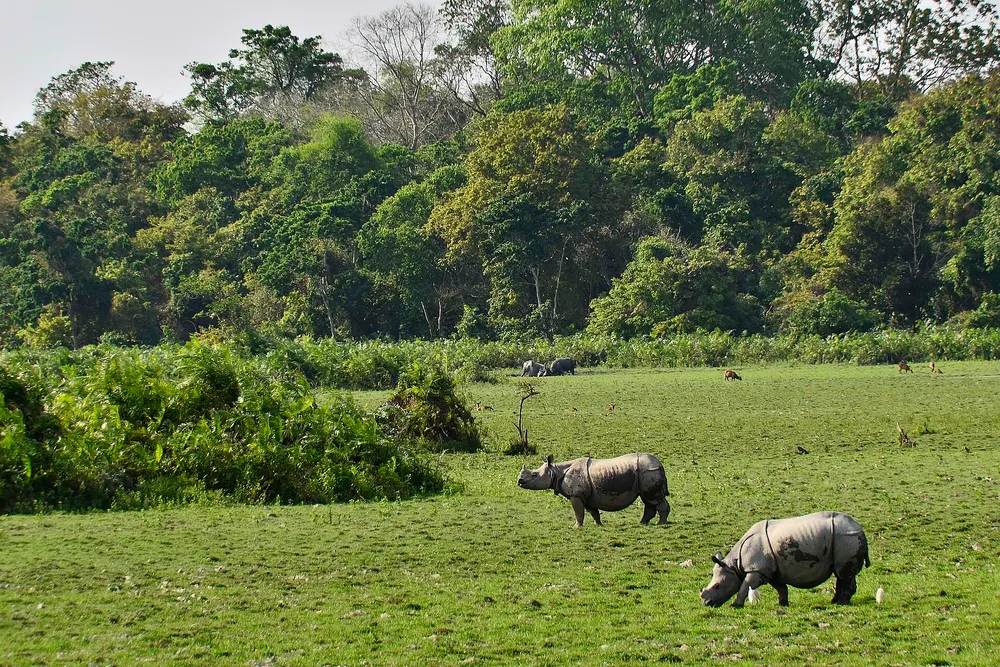
What you will realistically see
Kaziranga holds the largest population of the greater one-horned rhinoceros anywhere, and in the Central and Western ranges, in the open grassland, a rhino is a very likely sighting rather than a hoped-for one. That is unusual among Indian parks and it is the honest reason to come.
Beyond the rhino, the regular cast is wild water buffalo, swamp deer, hog deer, elephants in herds, and a long bird list that gets genuinely serious in the Eastern range and the wetlands.
Kaziranga is also a tiger reserve with a high tiger density, which is quoted often and misunderstood constantly. Density is not visibility. The grass is tall and the cover is heavy, and the overwhelming majority of visitors never see one. Go for the rhino and the grassland. Treat anything else as a bonus, because that is what it is.
The rules on the track, and why they are not decorative
Forest guides at Kaziranga are firm about a short list of things, and it is worth knowing why before you are asked.
- Stay seated in the jeep. Rhino and wild buffalo both charge vehicles. This is the rule that is actually about your safety rather than the animals'.
- Keep voices down and do not feed anything. Habituated animals near tracks become problem animals, and problem animals get moved or worse.
- No drones. Protected area, and it is not a grey zone.
- Observe the speed limits on the highway through the corridors. Kaziranga's animals cross NH 715 between the park and the Karbi Anglong hills, and the corridor stretches carry enforced limits for exactly that reason. This applies to the drive in, not just inside the park.
- Follow the guide without arguing. They decide how close the jeep gets and when it leaves. That judgement is the thing you are paying for.
Building more than one day around it
Most people give Kaziranga a single morning, and most people regret it. The park is roughly 240 to 250 km from Guwahati, a four and a half to five hour drive on NH 27 and NH 715, which is a long way to go for two hours in a jeep.
The additions that make the trip worth the drive are close by and under-booked:
- A second range in the afternoon. Kohora at dawn and Bagori after lunch gives you two genuinely different landscapes in a day, and the second safari is where people relax enough to actually look.
- The Kaziranga National Orchid and Biodiversity Park at Durgapur, minutes from the Central range, with orchid houses, a cactus and fern collection and local food stalls. It peaks in bloom around March and April and is worth an hour in any month.
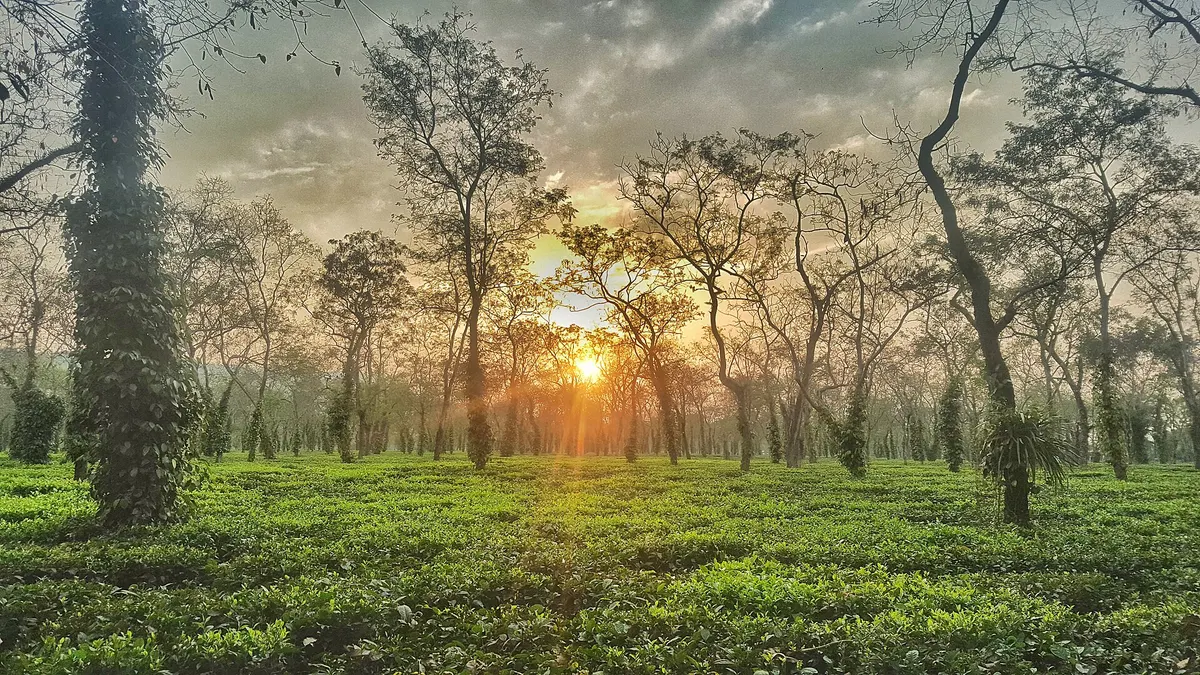
- The tea gardens along the highway south of the park, which run right up to the road and are at their best in the last light of the afternoon.
- Majuli, the river island on the Brahmaputra, reached by government ferry from Neamati ghat near Jorhat. The satras there are the reason to go, and it is a full day in its own right. We run it as Majuli satras by ferry from Jorhat, and the island is covered in more depth in our guide to Jorhat and Majuli.
Both Kaziranga days are tiered as needing a local operator rather than a self-drive, and that is not an upsell. The park cannot be improvised and the Majuli ferry runs to a timetable that changes with the river. For how the wider region has been pulling travellers for the last two seasons, our piece on why Northeast India became 2026's most-booked region covers the context, and the creator-led group trips that run through Meghalaya cover the other half of the Northeast loop.
You can see both Assam days in full on the Kaziranga and Majuli page, and the rest of the country on all experiences.
Quick answers
- When did Kaziranga reopen for 2026 to 2027? 3 October 2026, with jeep safaris in the Central (Kohora) and Western (Bagori) ranges.
- Does the government permit include a jeep? No. The portal sells park entry against your ID. The registered safari jeep and guide are arranged and paid separately on the ground.
- Where is the official booking portal? The Assam government's Sewa Setu system. Many sites with government-looking names are private agencies, and some say so in their own disclaimers.
- Which range should a first-timer book? Kohora or Bagori. They are open, they are close together, and the open grassland is where rhino are visible.
- What are the safari timings? Two slots, broadly a 7:30 to 10:00 am morning entry and a 1:30 to 3:00 pm afternoon entry, with later exit cut-offs. Confirm for your date and range.
- Are elephant safaris running? Not in October. They are scheduled to restart on 1 November, with limited dawn seats at Kohora and Bagori on a separate permit.
- Can I take my own car into the park? No. Only registered park jeeps enter, each with a forest guide.
- How many people fit in a jeep? Six visitors, plus driver and guide. The hire is charged per vehicle, so group size changes the per-person cost a lot.
- Will I see a tiger? Almost certainly not. The density is high and the grass is tall. Come for the rhino.
- Is October a good month? It is the quietest and greenest, with the tallest grass and the least certain sightings. December to March has the open sightlines and the crowds to match.
- How far is Kaziranga from Guwahati? Roughly 240 to 250 km, about four and a half to five hours on NH 27 and NH 715. Drive it in daylight.
- What if my range closes? It happens, especially early in the season. Keep a spare day, and check that whoever you booked through will reschedule rather than simply keep the money.