The Chilika Dolphin Boat Cannot Be Booked Online, and the Counter You Want Is the One at Satapada
Chilika's dolphin boats are hired by the boat at a jetty counter on the day, not per head on an app. Here is how the Satapada rates and routes work, which counter is the authorised one, and the days in the season when the boats do not go out at all.
Chilika is one of the few places in India where a wild dolphin surfaces within sight of a day trip from a beach town. It is also one of the places where travellers most often arrive having planned the wrong thing, because the boat at the centre of the day behaves nothing like a ticket.
There is no app for it. There is no seat on it. You cannot reserve it for a date three weeks out and arrive holding a confirmation. The dolphin boat at Chilika is hired whole, by the boat, at a counter beside the water, on the morning you turn up, and the only thing you really choose is which route and how long.
That single fact explains almost every bad Chilika day: the family that drove down expecting fixed departures, the couple who paid four times the published rate at a shed by the roadside, the group that reached the jetty at noon in a stiff onshore wind and found nothing going out. None of it is bad luck. It is a counter-based, weather-dependent hire that most people plan as though it were a bus.
What Satapada actually is
Chilika is the largest brackish water lagoon in Asia, and India's first Ramsar site. The Chilika Development Authority puts the waterspread between about 1,165 sq km in the monsoon and 900 sq km in summer, pear-shaped, roughly 64.5 km long and between 5 km and 18 km wide, fed by 52 rivers and rivulets and joined to the Bay of Bengal by a narrow channel about 32 km long.
Most of the lagoon is shallow enough to wade. The northern sector runs under half a metre deep; the deepest water, in the central sector, is about 3.7 m. Seawater pushing in through the sea mouth is what keeps the whole system brackish, and the mouth itself moves: littoral drift along the east coast shifts it, which is part of why Chilika was placed on the Ramsar Convention's threatened list in 1993, and why opening a new mouth in 2000 got it taken off again in 2002, the first site in Asia to come off that list.
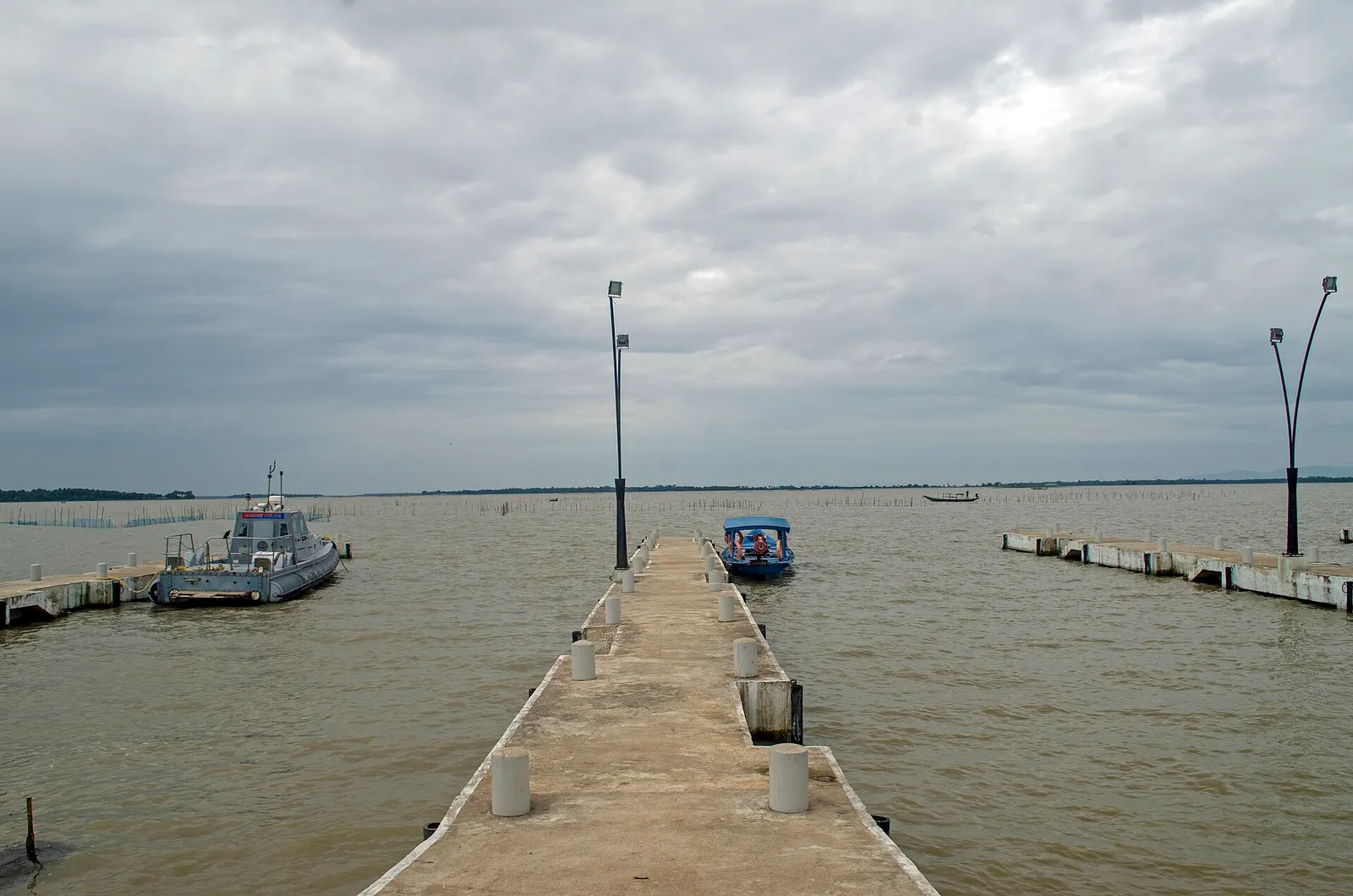
Satapada is the village on the lagoon's eastern side, about 50 km from Puri, where the dolphin channel and the sea mouth are closest to shore. It is where the jetty, the boats and the counters are. The CDA also runs a small interpretation centre there, effectively a mini museum of the lagoon's fishing communities, species and bird life, which is a better use of a waiting hour than most people realise.
How the hire actually works
At Satapada you walk up to a booking counter, pick a route from a short printed list, and pay for the boat. The boat is yours for that route. Six adults and two children is the standard capacity, and the price does not change whether two of you ride in it or eight.
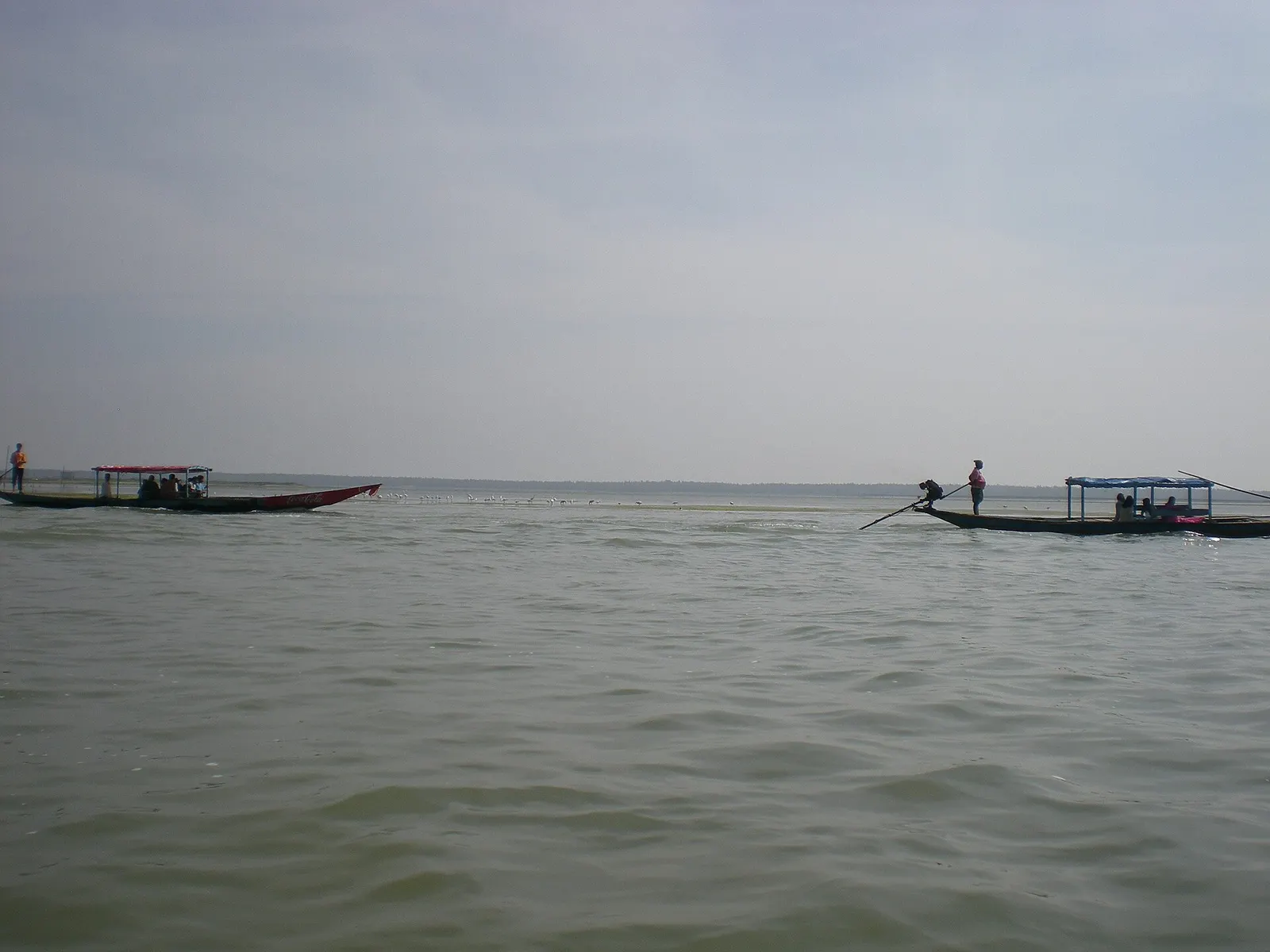
The route is what sets the clock. The Dolphin Motor Boat Association at Satapada, a society registered in 1997 whose rates its own site says are approved by the District Administration, Puri, publishes two: a one-hour run covering the boating and the dolphin channel, and a three-hour run that adds the sea mouth and the beach on the far side of the sandbar. Its published rates are Rs 1,300 for the hour and Rs 2,400 for the three hours, per boat, with extra passengers beyond the eight charged separately and capped. The counter works daily from 6:00 am to 6:00 pm.
OTDC, the state tourism corporation, sells the other legitimate route in: a Puri day tour that includes the drive and has a coordinator arrange boats at Satapada for the group. That is a coach day rather than a private one, and it arrives in the late morning.
What nobody sells is an online dolphin-boat seat for a future date. Tickets are bought at the counter for same-day boating. Treat any website offering you a confirmed timed slot on the lagoon weeks in advance with suspicion.
| Route | Roughly | What it covers | Published rate |
|---|---|---|---|
| Short run | About 1 hour | The dolphin channel and the near lagoon | Rs 1,300 per boat |
| Long run | About 3 hours | Dolphin channel, the sea mouth and the sandbar beach | Rs 2,400 per boat |
| Capacity | Either route | Six adults and two children; extras charged per head | Flat for the boat |
| Counter hours | Daily | Same-day hire only, no advance online booking | Cash is safest |
The counter problem, and the ten kilometres before it
This is the part that costs people the most money, and it happens before they reach the water.
The road down to Satapada is long and lightly built up, and travellers arriving by hired car or bus are frequently steered to a boating point that is not Satapada at all. Visitor accounts on TripAdvisor's Chilika page describe boards imitating official tourism signage, drivers taking groups to a different jetty entirely, and quotes several times the published rate for a shorter trip. The authorised office at Satapada signs itself as the government-authorised dolphin boat booking office for exactly this reason.
None of that makes the lagoon risky. It makes one instruction worth repeating to whoever is driving.
- Name the destination, not the activity. Say Satapada jetty, not "Chilika boating". The second phrase is what gets you redirected.
- Agree it before you leave Puri. If you are hiring a car for the day, settle the drop point in writing or over WhatsApp, not at a junction 10 km short of the jetty.
- Check the rate card before you pay. The authorised counter has published per-boat rates on display. A quote that is per head, or a long way above the card, is a signal to walk on.
- Pay at the counter, not to an intermediary. The receipt is for the boat and the route, and it is what the crew works to.
- Keep cash. Phone signal is patchy on the lagoon road and card acceptance at a jetty counter is not something to rely on.
What you will actually see, and what the boat should not do
Chilika holds the world's largest population of Irrawaddy dolphins, and the January 2026 census counted 159 of them in the lagoon, unchanged from the year before, as part of an Odisha-wide total of 765 dolphins across six species reported by The Tribune. One hundred and fifty-nine animals across hundreds of square kilometres of water is the number to hold in your head when you decide how much of your day to stake on a sighting.
Set your expectations from the CDA's own description rather than from a reel. The Irrawaddy dolphin is a shy animal, it says, and seeing an entire one is very rare: what surfaces is usually some part of the head or the back, briefly. Sightings on the dolphin run are common. They are never promised, and a boat that promises them is telling you something about how it intends to drive.
That matters more here than at most wildlife sites. OdishaTV has reported that motorised boats chase dolphins to get tourists a clearer view, that animals are injured by hulls and propellers, and that carcasses turn up in the lagoon. A local resident quoted in that report says boats are supposed to stay well clear of the dolphins' area and often do not. The Balugaon Divisional Forest Officer, Amlan Nayak, told the same outlet that the Chilika Development Authority and the Chilika Forest Division are acting jointly against operators who flout the rules.
As a passenger you have more leverage than you think. Ask the crew to cut the engine and wait rather than circle. Do not ask them to get closer. A boat sitting still in the channel sees more than a boat chasing a fin, and the person who pays for the boat sets the tone for the hour.
The days in the season when the boats do not run
Two suspensions catch people out, and both are predictable enough to plan around.
The census window in January. Every year the forest department counts the dolphins, and the count needs quiet water. In 2026 the census ran from 20 to 22 January, and ahead of it the Divisional Forest Officer wrote to the Satapada and Chilika motor boat associations prohibiting motorised and non-motorised boats, as OdishaBytes reported, with the daily restriction falling between 10 am and noon while 18 teams worked the lagoon. Dates shift year to year and are announced close in. If your trip falls in the third week of January, ask locally before you commit a morning.
Wind, rain and cyclone warnings. This is the bigger one, and it is decided at the jetty on the day, not in advance. Chilika sits on a stretch of coast that takes Bay of Bengal systems through October and November. As this is published, the IMD has a red warning out for Puri district among six Odisha districts, with heavy to very heavy rain forecast from 25 to 27 October 2026 and a developing cyclone expected to make landfall near the Andhra and south Odisha coast on the night of 28 October, as reported by The Week. On days like that the boats stay tied up, and that is the correct decision.
The practical consequence is to treat the lagoon as the flexible half of a Puri itinerary rather than its anchor. If the boats are off, the day still works: the painters' village, the Sun Temple and the coast road are all unaffected by a choppy lagoon.
When to go, month by month
The honest season for Chilika is the cool, dry half of the year, and the peak of it overlaps with the bird season rather than the dolphin one, because the dolphins are resident and the birds are not.
| Period | Lagoon conditions | Worth knowing |
|---|---|---|
| Late October to November | Season opening, water settling | Cyclone systems still possible; migratory birds beginning to arrive |
| December to February | Best overall, calm mornings | Peak birds and peak visitors; the January census can close a morning |
| March to May | Hot, hazy, water falling | Boats run, but midday on an open boat is punishing |
| June to September | Monsoon, lagoon at its fullest | Wind and rain suspensions are frequent; not the trip to plan around |
If the birds are the point, Satapada is not the only answer
Chilika is the largest wintering ground for migratory waterfowl on the Indian subcontinent, and the numbers are genuinely large. The January 2026 mid-winter census counted over 11.32 lakh birds of more than 196 species across the lagoon, with Nalabana Bird Sanctuary alone rising to 3,97,587 birds of 106 species from 3,43,226 of 92 species the year before, per OrissaPOST. Northern Pintail led the count.
Nalabana is an island in the middle of the lagoon, notified as a bird sanctuary, and it emerges from the water after the monsoon. It is a long way off the Satapada dolphin route, and the longer hires that mention it are covering distance rather than birding properly.
Serious birders usually go to the lagoon's northern edge instead, to Mangalajodi in Tangi, where the boats are small, unmotorised and rowed by villagers who used to trap the birds they now guide people to. From November to February that is the better morning for anyone carrying a long lens, and it is a different trip from a dolphin run, not an add-on to one.
How to build the day from Puri
Satapada is about 50 km from Puri and the drive takes roughly an hour and a half. The lagoon wants the morning: the water is calmer, the light is better and the boats are less crowded before the coach groups arrive. Everything else near Puri is happier in the afternoon.
That argues for one shape of day, and it is the one that most people arrive at only on a second visit.
- Leave Puri early enough to be at the Satapada counter soon after it opens, which in practice means a start before seven.
- Hire the boat for the route you want rather than the shortest one on offer. The sea mouth, where the lagoon meets the Bay of Bengal across a narrow spit, is the part of the trip people remember longest.
- Give the interpretation centre twenty minutes while the boats sort themselves out. It is the only place on the trip that explains what you are looking at.
- Eat on the way back rather than at the jetty, and keep the afternoon for Raghurajpur, the pattachitra village 14 km from Puri where almost every house on the street is a studio.
- Keep the Sun Temple and the Marine Drive for a different day. Konark is 35 km in the other direction and deserves its own morning.
The version that survives a bad morning
Chilika is a good example of the thing this blog keeps running into: the booking that decides whether a day works is a local, cash, same-day transaction that no national platform touches. We wrote about the pattern at length in why booking travel experiences in India is still hard, and the lagoon fits it almost exactly. The same split shows up at Periyar, where you are booking a sailing time rather than a boat and at Kaziranga, where the permit and the jeep are two separate purchases.
What can be organised in advance is everything around the boat. That is how GoExplorer sells the day: Chilika at Satapada and Raghurajpur is a private car and driver from your stay in Puri at 6:30 am, down the lagoon road, with the driver pointing you at the right counter and then waiting at the car park for however long your boat is out, before the painters' village on the way back. The boat hire stays yours to pay at the jetty, for the reason this whole article exists: nobody can sell you a dolphin, and nobody honest will sell you a boat that the weather may not let out.
If the lagoon is closed on your date, the coast road is not. Konark Sun Temple and the Marine Drive is the same shape of day in the opposite direction, built around getting to the chariot before the heat and the coaches.
Frequently asked questions
Can I book a Chilika dolphin boat online? Not as a seat for a future date. Boats are hired at the counter at Satapada for same-day boating. What you can arrange in advance is the car that gets you there and waits.
Is the boat priced per person? No. It is priced per boat for a route, with a standard capacity of six adults and two children, and extra passengers charged separately up to a limit.
How long is the boat trip? The short route runs about an hour and covers the dolphin channel. The long route runs about three hours and adds the sea mouth and the beach on the sandbar.
What time should I reach Satapada? As early as you can. The counter opens at 6:00 am, the water is calmest in the morning and the coach groups arrive later. Leaving Puri before seven is the usual answer.
Will we definitely see dolphins? No. Sightings are common and never certain, and what you see is a brief glimpse of a back or a head rather than a leaping animal. Ask your crew to wait quietly rather than chase.
When are the boats suspended? In high wind, heavy rain or a cyclone warning, decided at the jetty on the day, and for a few hours a day during the annual January dolphin census. Dates for the census are announced close in.
Is Satapada better than Barkul or Rambha for dolphins? For dolphins, yes. Satapada sits nearest the dolphin channel and the sea mouth. The western-shore points are better for the open lagoon and the islands.
What about birds? Chilika's bird numbers run into the lakhs in winter, but the dolphin run is not a birding trip. For that, go to Mangalajodi on the northern edge between November and February.