Jaisalmer Desert Safari: Sam or Khuri, Sunset or Overnight, and Why October Is the Switch
A desert safari in Jaisalmer is four different products sold under one name. Here is what separates Sam from Khuri, how long a camel ride really lasts, what you should agree before you mount, why Desert National Park is not the dunes, and the season window that decides all of it.
From April to June, Jaisalmer regularly passes 45 degrees and the middle of the day is simply unusable. Then the heat breaks, and for roughly six months the Thar becomes one of the most rewarding places in India to spend an evening. That switch happens around now.
Which is also when a particular kind of confusion starts. Search for a desert safari in Jaisalmer and you will be offered a thirty minute camel ride, a jeep run over the dunes, a night in a tented camp with a folk performance and dinner, and a wildlife permit for a national park, all under the same two words. They are not variations of one thing. They are four separate decisions, at four price points, in two different directions out of town, and most people only discover which one they bought after they have arrived.
This guide sorts them out: the season window and what each month actually feels like, the real difference between Sam and Khuri, how long a camel ride lasts and what to settle before you get on, why Desert National Park is a different trip entirely, and how the rest of the desert road fits around sunset.
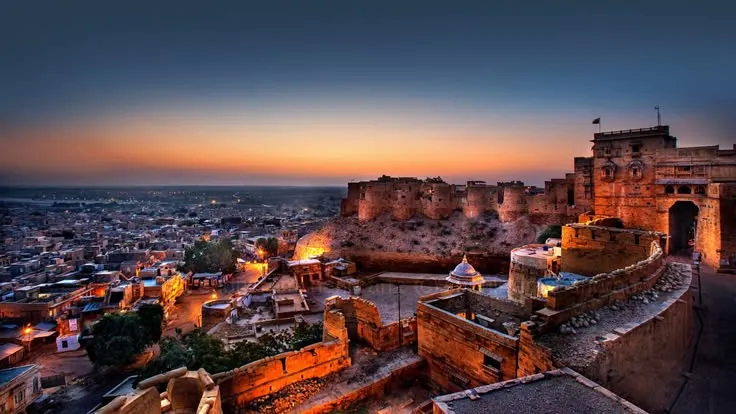
The season, month by month
Jaisalmer has one usable season and it is not subtle. October to March is the window; April to June is heat that closes the day down, and the brief monsoon in between brings little rain but a lot of haze and dust.
Inside that window the months are genuinely different, and the difference matters more than people expect, because almost everything worth doing here happens outdoors in the last two hours of light or the first two.
| Month | Typical daytime high | Typical night low | What it means for a dune evening |
|---|---|---|---|
| October | Mid 30s | Low 20s | The switch. Still warm at noon, but sunset is comfortable and the crowds have not arrived. |
| November | Around 30 | Mid teens | Arguably the best balance of weather and daylight. Also the start of peak season. |
| December | Mid 20s | 7 to 10 | Beautiful days, genuinely cold nights. A camp without proper bedding is a mistake here. |
| January | Mid 20s | 7 to 10 | Same as December, plus occasional cold waves. Peak season pricing throughout. |
| February | Upper 20s | Low teens | Excellent, and the month the Desert Festival usually lands in. |
| March | Low to mid 30s | Upper teens | The last good month. By the end of it the heat is returning. |
If you are choosing between October and the deep winter months, the honest trade is comfort against company. October and March are warmer by day and much quieter. November to February are lovely and busy, and at Sam in particular the dunes fill up noticeably before sunset.
For how this fits a wider India plan, our season by season calendar covers which regions open as the desert does.
What a desert safari actually means here
Before you compare prices, work out which of these four you are buying. The word safari is doing a lot of unearned work in Jaisalmer.
- A sunset dune visit. You drive out in the afternoon, walk on sand, watch the sun go down, drive back. No animal, no tent, no overnight. For a lot of people this is all they actually wanted.
- A camel ride. Usually short. Published options cluster around 30 to 45 minutes, which is enough to get out of sight of the car park and back, with longer rides of one to two hours available if you ask for them in advance.
- A jeep safari. A vehicle driven fast over the dune crests. It is the loudest thing on the sand and it is not compatible with anyone else's sunset, which is worth knowing whichever side of it you are on.
- An overnight desert camp. A tented property near the dunes, usually with dinner and a folk music and dance performance. This is a stay, not an excursion, and it should be judged like one.
The reason this matters is that published prices for a Jaisalmer safari range from a few hundred rupees to several thousand, and almost none of that spread is quality. It is inclusions. A short ride at the dunes and a night in a tent with dinner and transfers are different purchases, and quotes for both get posted under the same heading.
Sam or Khuri
This is the decision that shapes the evening, and it is rarely presented clearly. Both are dune areas west and southwest of town, both are inside an hour's drive, and they are not interchangeable.
| Sam | Khuri | |
|---|---|---|
| Distance from Jaisalmer | Roughly 40 to 45 km west | Roughly 45 to 50 km southwest |
| Character | The big, high, photogenic ridges | Lower, softer, more scattered dunes |
| Crowd | Busy, and visibly so before sunset | Much quieter |
| Camps and operators | Many, from basic to elaborate | Fewer, generally simpler |
| Activities on offer | Camel, jeep, quad bikes, performances | Mostly camel rides and village walks |
| Best for | First visit, families, anyone who wants the postcard dune | A second visit, or anyone whose priority is quiet |
The short version: Sam gives you the dune you have seen in photographs, along with everyone else who has seen that photograph. Khuri gives you something closer to what people imagine when they say desert, with a village attached and far less going on.
Neither is the wrong answer. What is a mistake is arriving at Sam at six in the evening in December expecting solitude, or driving to Khuri expecting the towering ridges and the full fairground of activities. If you have one evening and have never seen the Thar, go to Sam and go early enough to walk away from the car park. If you have two, or you have been before, Khuri is the better one.
Day trip or overnight camp
A tented camp in the Thar in December, with the temperature in single figures and the sky completely clear, is a genuinely memorable night. A tented camp in a row of twenty-five other camps, with a generator running and music from three directions, is not. Both exist within a few kilometres of each other at Sam, and the photographs look similar.
So the question is not whether camps are good. It is whether you want a stay or an evening. If what you want is the sand, the light and the silence, an afternoon run that gets you out there for sunset and back to a proper bed in town does that job well, and it removes the part people most often regret, which is being stuck at a camp whose neighbours you did not choose.
If you do want the night, two things are worth checking before you book: how far the camp actually sits from the nearest other camp, and what the bedding is. Desert nights here drop fast and far. A canvas tent with thin blankets in January is the single most common complaint about this experience.
Desert National Park is a different trip
This is the most common mix-up of all, and it is worth being precise about, because the two things are sold a few metres apart.
Desert National Park is not the dunes you ride camels on. It is a protected area of about 3,162 square kilometres of Thar, notified in 1980, with roughly 1,900 square kilometres in Jaisalmer district and the rest in Barmer. It is the only place where Rajasthan's state bird, state animal, state tree and state flower all occur naturally, and it exists primarily for one species.
That species is the Great Indian Bustard, locally the godawan, and it is critically endangered. The Rajasthan Forest Department puts the population within the park at roughly 35 to 40 birds, concentrated in the Sudasari landscape in the northern part of the sanctuary. Sudasari is about 55 km from Jaisalmer, which is a comparable distance to the dunes but in a different frame of mind entirely.
- A permit is required. Entry is through the Forest Department, from the office of the Deputy Director, Desert National Park, on Khuri Road in Jaisalmer. Carry photo ID.
- Fees are modest but inconsistently reported. Published figures for entry, vehicle, guide and video camera charges differ between sources. The department's own counter is the only reliable answer, and that is not a dodge, it is the actual situation.
- Park hours are roughly 10:00 am to 5:00 pm, with early morning and late afternoon game drives arranged separately. Those are also the only hours worth going.
- November to March is the window, for temperature and for bird activity both.
- This is not a dune bashing environment. It is a conservation area for a bird with a few dozen individuals left inside it. Go in expecting patient, quiet, low-speed driving and a guide who is looking rather than performing.
If you have any interest in birds or in desert ecology, this is the most interesting half day available in Jaisalmer and almost nobody books it. If you do not, skip it cheerfully and spend the time on the dunes instead. What you should not do is assume a camel ride at Sam is the national park, because it is not.
The rest of the desert road, and why it runs late
Everything worth seeing outside Jaisalmer town sits on the same road west, which means your dune evening can carry three other stops at no extra driving. It also means the whole run has a correct direction of travel, and it is backwards from sunset.
- Amar Sagar, about 6 km out. A Jain temple complex and a stepped tank, restored over decades and usually close to empty. A good quiet start before the light gets interesting.
- Bada Bagh, a ridge of sandstone chhatris, one for each ruler of Jaisalmer, standing above what was once a dammed mango garden. Wind turbines turn on the ridge behind them. At noon it is a row of grey stone; forty minutes before sunset it is the photograph people come for.
- Kuldhara, a Paliwal Brahmin village established around the thirteenth century and abandoned by the early nineteenth, for reasons that are genuinely unknown. Failing water supply, an earthquake and the local legend about a state minister's demands all get offered. The Archaeological Survey of India looks after the site now. The lanes and doorframes are still standing, and they are far more affecting in low light than at midday. Entry is ticketed and no one is admitted after sunset.
- The dunes, Sam or Khuri, for the last of the light.
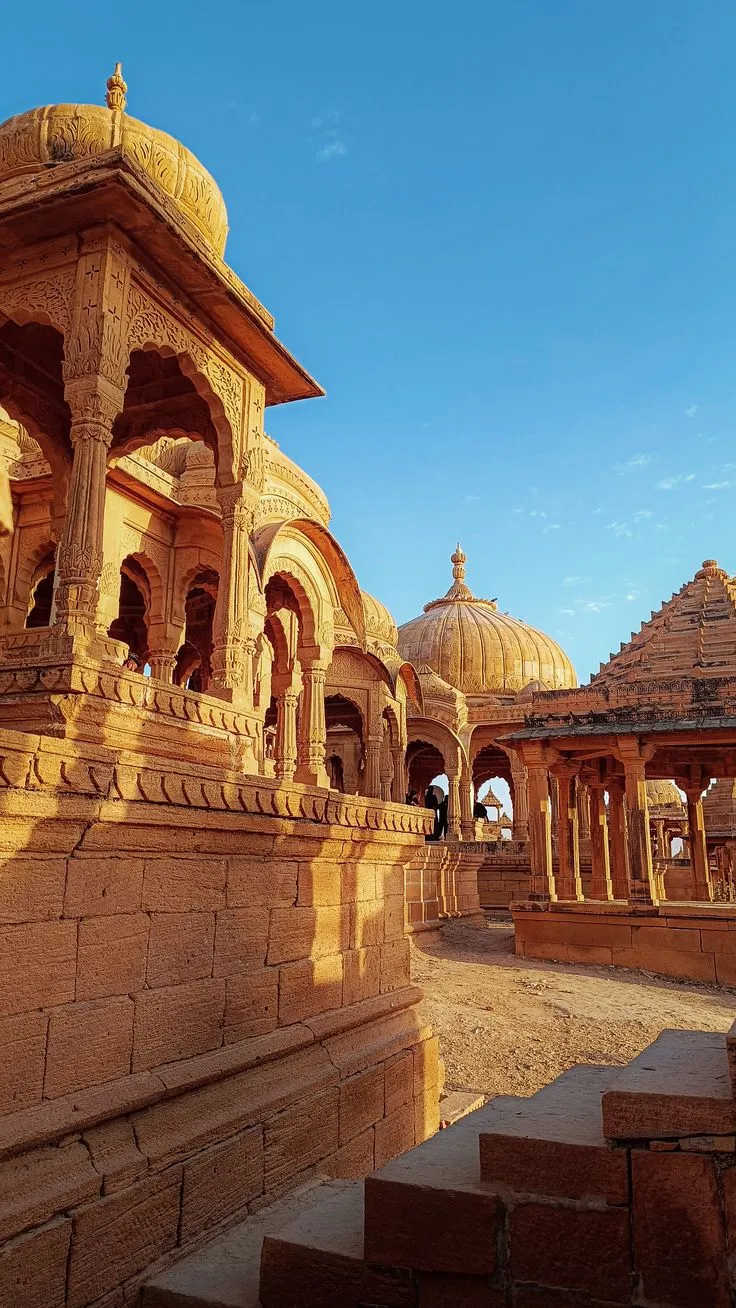
Run in that order, the afternoon works. Run it the other way, starting at the dunes at ten in the morning, and you will see four things in the worst light each of them has, and reach Kuldhara after it closes.
One practical warning: there is nothing between these stops. Amar Sagar to Bada Bagh to Kuldhara to the sand is roughly 50 km of open desert road with no transport in between, and effectively none at all after dark. Whatever gets you out there needs to be waiting for you at each stop and willing to drive back at night. That is the part of this evening people underestimate, and it is why we sell the run west as one afternoon with the vehicle included rather than as a list of places.
Where to stay, and the one thing worth knowing about the fort
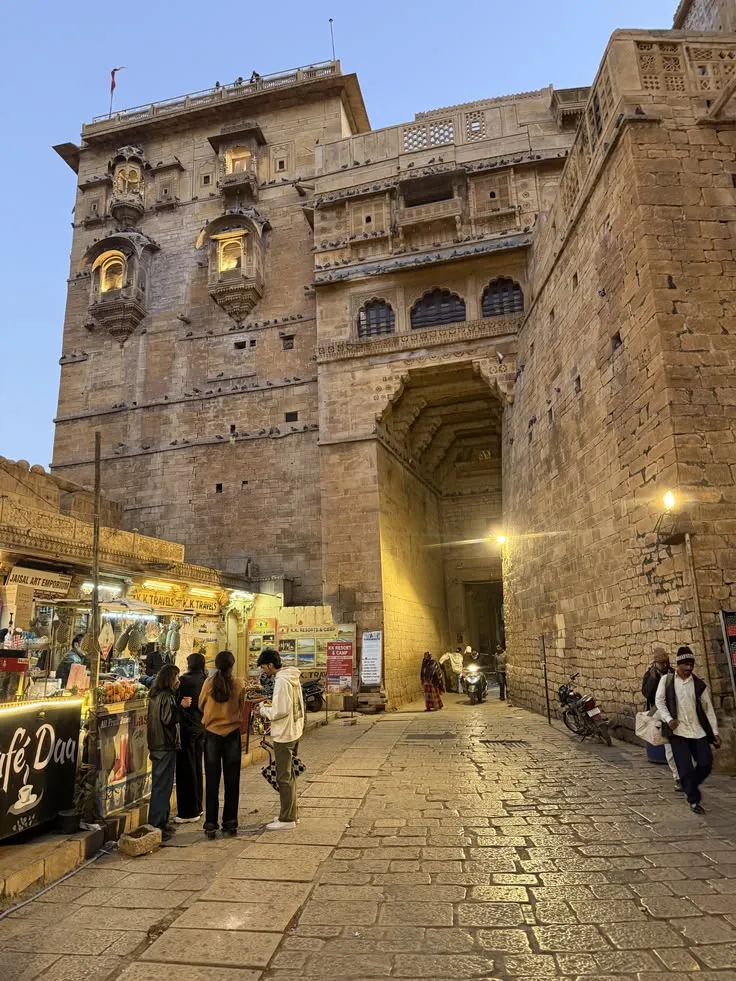
Jaisalmer Fort was founded in 1156 and became a UNESCO World Heritage Site in 2013 as one of the six components of the Hill Forts of Rajasthan. What makes it unusual among those six is that its township was part of the fort from the beginning and people still live inside it, several thousand of them. UNESCO counts that living quality as a large part of its value.
It is also the fort's problem. The structure sits on clay-rich subsoil, and the medieval drainage was built for a few hundred residents, not for thousands of people plus hotels, restaurants and shops serving a tourist season. Water seepage into that subsoil has been linked to the collapse of a significant number of structures inside the walls over recent decades, and conservation groups have for years asked both residents and visitors to reduce water use inside the fort, including by staying outside it.
We are not going to tell you where to sleep. But it is a real consideration and almost no booking page mentions it, so: staying in the town below and walking up costs you a sunrise on the ramparts and saves the fort a shower. If you do stay inside, use less water than you would at home. Either way, see it early in the day, before the lanes fill and the heat arrives.
The Desert Festival moves every year
The Jaisalmer Desert Festival, or Maru Mahotsav, is run by Rajasthan Tourism across the fort and Sam, with camel races, folk music and dance, turban tying and the moustache competition. It is the busiest the town gets.
The thing to know is that it follows the lunar calendar rather than a fixed date, landing around the Magh full moon, which is why it slides through February and occasionally into early March. Dates circulating online for a given year frequently disagree with each other. Check the official Rajasthan Tourism listing before you book flights around it, and book accommodation unusually early if you are going, or deliberately avoid the week if you are not.
Putting two days together
The shape that works is simple, and it is dictated by light rather than by distance. Jaisalmer's sights are concentrated: the town ones sit inside about 15 km, and the desert ones inside about 50.
- Morning one: the fort and the havelis. Fort and the Jain temples inside the walls first, while the temples are still open and the lanes are empty. Patwon ki Haveli through the middle of the day when shade matters. Gadisar Lake at the end, when the light comes back. That is a day's worth on its own.
- Afternoon two: the run west. Out around one, Amar Sagar and Bada Bagh while the light builds, Kuldhara in the middle, dunes for sunset, back after dark.
- Optional, early on either day: Desert National Park. A dawn or late afternoon drive at Sudasari, permit arranged in advance, if birds interest you at all.
What does not work is stacking the fort and the desert into one day. The fort is unbearable at noon and the desert is pointless before four, so a single day forces you to rush the thing you actually came for.
If the Thar appeals and the dates do not, the salt flats of Kutch run on a similar seasonal logic with a stranger landscape at the end of it, and we have a full guide to that season and its permits.
You can see the Jaisalmer days in full on the Jaisalmer experiences page, and the rest of the country on all experiences.
Quick answers
- Is October too early for Jaisalmer? No. It is the first comfortable month, and the quietest of the good ones. Noon is still warm; sunset is excellent.
- Sam or Khuri for a first visit? Sam, arriving early enough to walk away from the vehicles.
- Do I need an overnight camp to see the dunes? No. An afternoon run gets you there for sunset and back to town the same night.
- How long is a camel ride? Commonly 30 to 45 minutes. Ask for one to two hours in advance if you want to get properly away from the crowd.
- Is the camel ride usually included in a safari price? Not reliably. Rides at the dunes are run and priced by the operators out there. Confirm before you commit.
- Is Desert National Park the same as the dunes? No. It is a protected area requiring a Forest Department permit, roughly 55 km out at Sudasari, and it is about wildlife rather than sand.
- When is the Desert Festival? February most years, set by the Magh full moon, so it moves. Confirm on the official Rajasthan Tourism listing.
- Should I stay inside the fort? Your call, but the fort has a documented water seepage problem and conservation groups suggest staying outside and using less water inside. Worth factoring in.