Most Shillong Day Trips Are Not Day Trips, Which Is Why Meghalaya Itineraries Fall Apart
Dawki, Sohra and the double decker root bridge all get sold as day trips from Shillong. Here is what the hill roads actually allow in a day, which two trips genuinely work, and the registration rule that catches travellers out at check-in.
Almost every Meghalaya itinerary on the internet is built the same way. Base yourself in Shillong for four nights, then run out and back each morning: Sohra one day, Dawki and Mawlynnong the next, the double decker root bridge after that, Laitlum if there is time.
On a map it looks tidy. Nothing is more than about a hundred kilometres away. The problem is that a hundred kilometres of East Khasi Hills road is not a hundred kilometres, and two of the things on that list are not day trips at all, in the sense that no amount of early starting makes them fit.
This is the single most common way a Meghalaya trip goes wrong, and it is entirely predictable. What follows is the honest version: which runs out of Shillong genuinely work in a day, which ones quietly need a night somewhere else, what November does to all of it, and the paperwork rule that surprises people at check-in rather than at a checkpoint.
Why Shillong looks closer to everything than it is
Shillong sits at about 1,500 m on a plateau, and every road out of it drops, climbs, or does both repeatedly. Average speeds on those roads sit far below what the distance suggests, and they fall further on the stretches that matter, where the surface narrows to a car and a half and is shared with village traffic, livestock and parked trucks.
Dawki is the clearest example. The driving distance from Shillong is around 80 km, and route planners such as Rome2Rio will quote it at a little over an hour. Operators who actually run the road, and travellers who have been on it, consistently report two and a half to three hours each way, as this day-trip write-up and the visitor accounts on Tripadvisor's Dawki page both describe. That is a five to six hour difference across a return trip, and it is the gap that eats the day.
The second thing the map hides is that the attraction itself often has a walk attached, and the walk is the real clock. A viewpoint you can stand at is an hour. A gorge you have to descend into is a day.
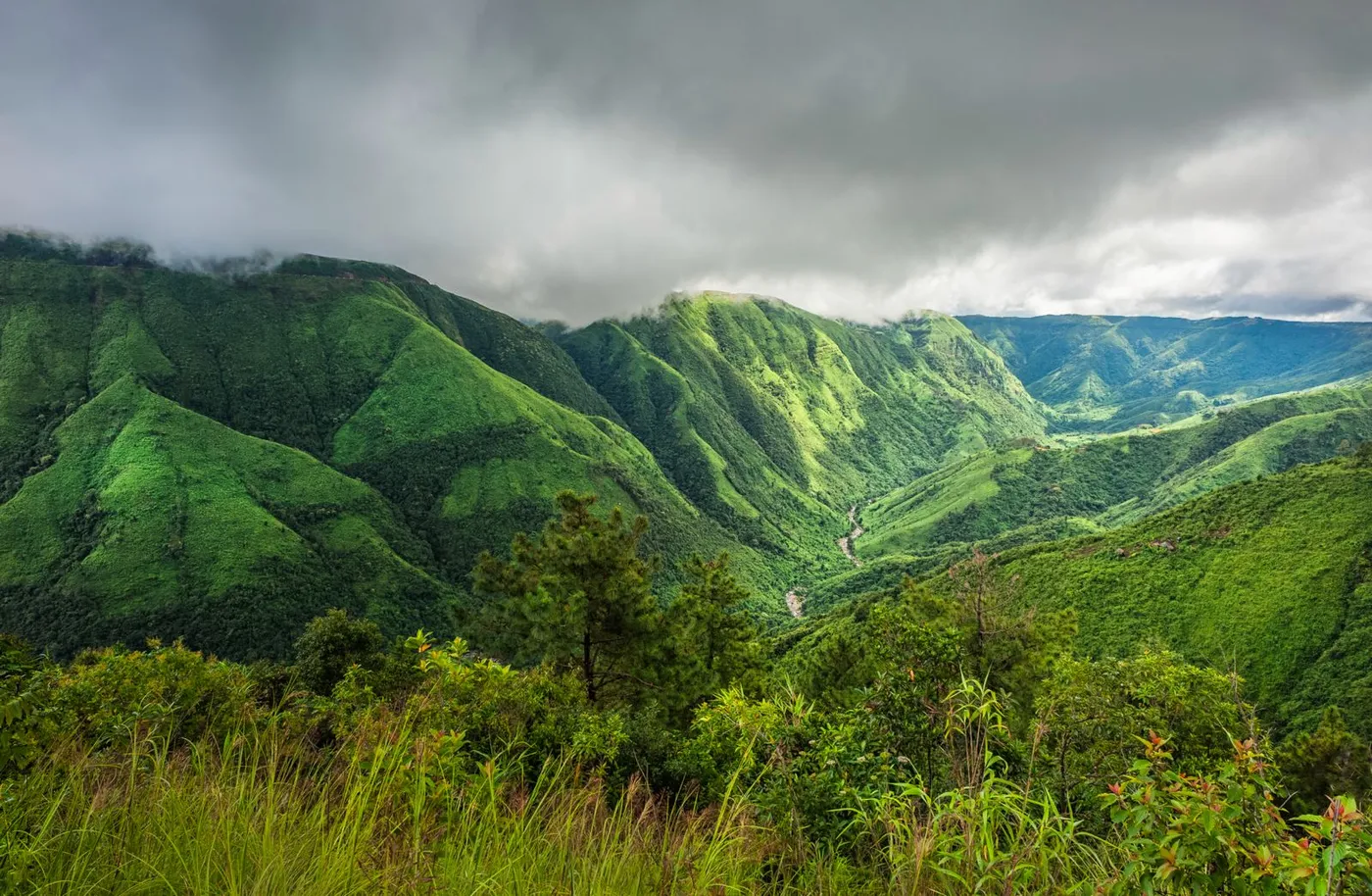
The classic list, with honest driving times
Here is the usual Shillong day-trip list with the round-trip driving time rather than the one-way distance, which is the number that decides whether a day works.
| Run out of Shillong | One way | Driving, there and back | Honest verdict |
|---|---|---|---|
| Laitlum canyons and Smit | About 25 km | Roughly 2 to 2.5 hrs | A genuine half day, best at dawn |
| Mawphlang sacred forest | About 25 km | Roughly 2 hrs | A genuine half day, fits beside a second stop |
| Sohra, the Cherrapunji viewpoints | About 55 km | Roughly 3.5 to 4 hrs | Works as a long day if you skip the gorge |
| Dawki and Shnongpdeng | About 80 km | Roughly 5 to 6 hrs | Technically possible, rarely worth it |
| Mawlynnong, added to Dawki | About 90 km | Roughly 6 hrs plus | Not a day trip from Shillong |
| Nongriat, the double decker bridge | About 65 km to Tyrna | Roughly 4 hrs, plus 5 to 7 hrs on foot | Not a day trip from Shillong |
The two that really are day trips
Both of the short runs sit southeast and southwest of the city, close enough that the drive is a prelude rather than the event. They are also the two where the cloud and the light genuinely reward an early start, which is the opposite of the long runs where an early start is just damage control.
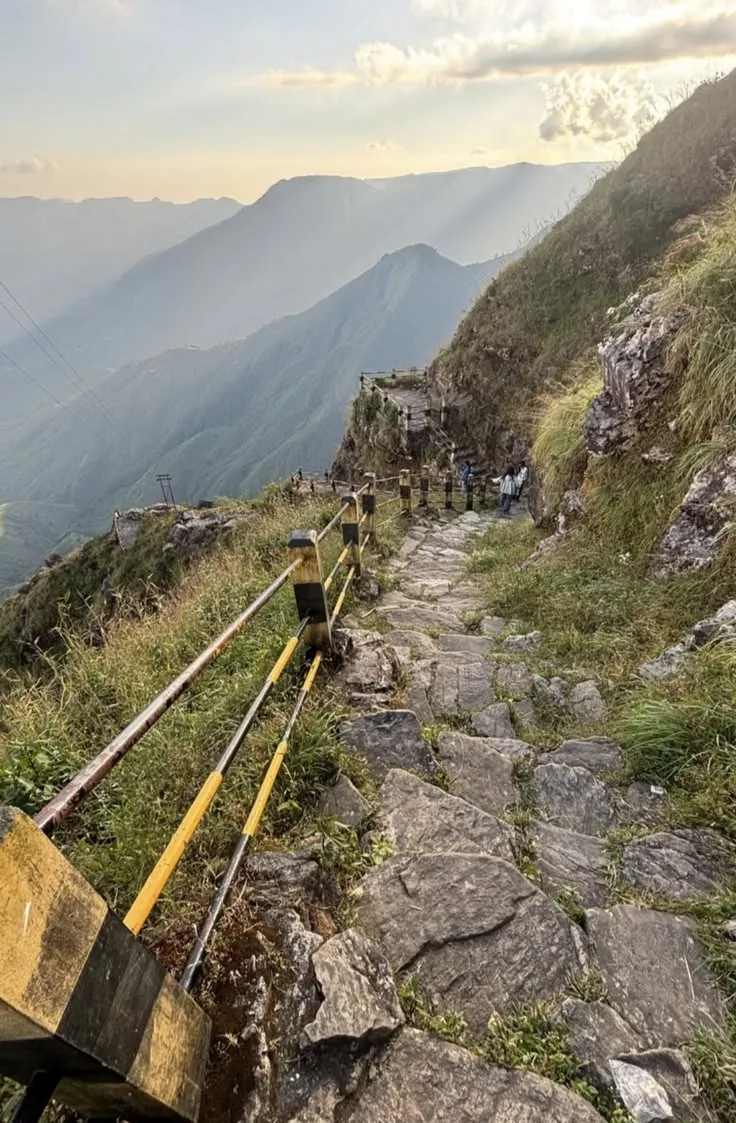
Laitlum, about 25 km out through Smit, is the most startling view in the East Khasi Hills. The Khasi name means the end of the hills and it is a literal description: the plateau you have been driving across stops, and a green amphitheatre of gorges opens below with cloud moving through it. There is a stone staircase cut down the cliff to the village of Rasong, which the people who live there use to carry everything they own up and down. Walk as far as you like, and remember that the whole thing is a climb back.
What catches people out at Laitlum is not the road. It is that there is nothing at the top. No ticket counter, no railing, no taxi rank, sometimes a tea stall and sometimes not, and patchy signal in places. Travellers who get dropped there without a vehicle waiting have a genuine problem getting back.
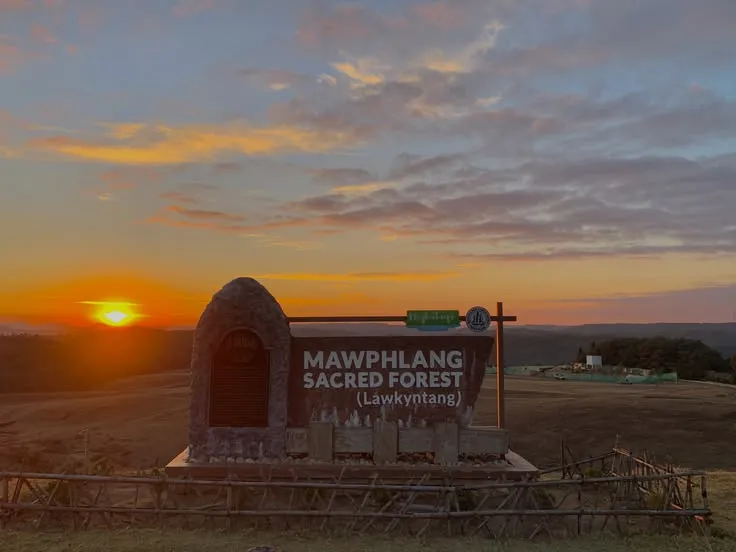
Mawphlang, about the same distance southwest on the Sohra road, is a grove of trees nobody has taken a leaf from in centuries. The line where open grassland becomes dense forest is abrupt and entirely man-made, maintained by a taboo rather than a fence. Standing monoliths mark the clan ritual ground at the edge, and the Khasi Heritage Village sits next door with reconstructed houses from across the hills.
Mawphlang has an entry procedure, and it is the useful kind. Visitors report an entry fee of about Rs 10 a head with small camera and vehicle charges on top, a guide fee in the region of Rs 300 to Rs 500 depending on how long you want, and gate hours of roughly 9:00 am to 4:30 pm, per Tripadvisor's Mawphlang page and this guide to the heritage village. Going in with a village guide is the rule, not an upsell: the guides come from the community that protects the grove, and they are the reason you understand what you are looking at. Carry small cash and confirm the figures at the gate, because fees like these change without being announced anywhere.
The ones that need a night, and why
Two famous stops get sold as Shillong days and should not be.
Nongriat and the double decker root bridge. The trek starts at Tyrna, past Sohra, and it is roughly 3,500 stone steps down and the same 3,500 back up. Accounts of the walk put the descent at one and a half to two and a half hours and the climb back at two and a half to four, for a total of four to six hours on foot before anything else, as Meghalaya Tourism's own Nongriat page and this detailed trek guide set out. Add four hours of driving from Shillong and you are attempting a ten to twelve hour day with a serious staircase in the middle of it. People do it. They also finish the climb in the dark, see the bridge for fifteen minutes, and skip Rainbow Falls, which is the part most of them wanted. A night in Nongriat, or at least in Sohra, turns the same trek into a good day.
Dawki and Shnongpdeng. The Umngot is genuinely as clear as the photographs suggest in the dry months, and it is five to six hours of driving away and back. Arrive at two in the afternoon, which is what a Shillong start produces, and you get the river at its most crowded, in flat light, with a boatman who wants to finish for the day. The boats here are hired by the boat rather than per head, settled at the ghat, with rates that visitors report between roughly Rs 500 and Rs 1,200 depending on season and length and that do not change much whether two of you ride or six. One night at Shnongpdeng, and you get the river early, which is a different place entirely.
The honest fix for both is the same, and it is not a faster car. It is a second base. Two nights in Shillong and two in Sohra covers more of Meghalaya, more calmly, than four nights in Shillong ever will.
November is the window, and it is a narrow one
Meghalaya's reputation is built on rain, which makes the shoulder after the monsoon the best travelling weather of the year and the reason late October and November fill up.
Shillong in November runs at roughly a 21 degree day and a 10 degree night, with monthly rainfall in the region of 40 to 55 mm, a fraction of what falls in June, according to Weather Spark's November profile and Weather2Travel's Shillong averages. The practical effect is clear skies, cloud that sits in the gorges in the morning and lifts, waterfalls still carrying volume from the monsoon, and leech season over on the forest trails.
The crowds have arrived too. State tourism figures reported this year put Meghalaya's 2025 arrivals at about 18.5 lakh, up from roughly 16 lakh in 2024 and 13.85 lakh in 2023, per UNI. On a plateau where most of the famous stops are a single village road and a car park, that is felt as queues at viewpoints and traffic on the Sohra road rather than as sold-out tickets.
There is also one date worth knowing this year. Ka Pomblang Nongkrem, the Khasi thanksgiving festival with the goat offering, the women's dance and the warriors' sword dance, is being held at Smit on 1 and 2 November 2026, according to The Shillong Times. Smit is the seat of the Hima Khyrim, about 11 km south of Shillong, and it sits directly on the road out to Laitlum. If your dates cover it, that is the single best morning in the hills, and the road will be busy.
| Period | Conditions | Worth knowing |
|---|---|---|
| Late October to November | The best window, clear and dry | Morning cloud in the gorges, full waterfalls, busiest roads |
| December to February | Cold, clear, waterfalls thinning | Excellent for the viewpoints, weakest for the falls |
| March to May | Warm, hazy, pre-monsoon showers | Green returning; afternoon storms shorten the day |
| June to September | Monsoon, the real Meghalaya | Spectacular water, landslips and closures, leeches on the trails |
The paperwork nobody mentions until check-in
Meghalaya does not require an Inner Line Permit, unlike neighbouring Sikkim's protected areas. There is nothing to apply for and no checkpoint that turns you back. What exists is a registration obligation that sits on the place you sleep rather than on you.
In June 2025, after a criminal case in the Sohra area, the state directed every accommodation provider in Meghalaya, hotels, homestays, guesthouses, lodges and bed and breakfasts, to register the details of the tourists they host, with guest counts, origin and ID uploads required and responsibility for compliance falling on the provider. The Shillong Times reported the order, and Hospitality Biz India set out what providers now have to file, including a no objection certificate from the district administration and police.
This sits on top of a longer-running framework. Amendments to the Meghalaya Residents Safety and Security Act approved in 2019 made registration mandatory for non-residents intending to stay more than 24 hours in the state, as Drishti IAS summarised at the time.
For a traveller the consequence is small and entirely avoidable. Carry original photo ID for every adult in the group, expect it to be photographed or uploaded at check-in rather than glanced at, and prefer stays that are registered, because an unregistered homestay is the one with an incentive to skip the step. Nothing about this is a permit, and nobody is going to stop your car.
What you are actually booking at each stop
The thing that makes Meghalaya harder to plan than it should be is not information. It is that almost none of the day is a bookable transaction. The pattern is one this blog keeps running into, and we wrote about it at length in why booking travel experiences in India is still hard.
On a Shillong week it shows up as four separate small frictions, none of them solvable from an app:
- Laitlum has no counter at all. Nothing to book, nothing to pay except an occasional village or parking charge collected at the rim. The only decision that matters is whether a vehicle waits for you.
- Mawphlang is a gate fee and a guide, in cash. Small amounts, no card, and entry only with a registered local guide from the village that protects the grove.
- Dawki boats are hired whole at the ghat. Per boat, not per head, agreed with the boatman on the day. Counters and intermediaries short of the ghat are where people overpay.
- The root bridge is free and the climb is not negotiable. There is no ticket to buy and no shortcut to purchase. What you are really managing is daylight and knees.
The same split turns up all over the region. At Kaziranga the permit and the jeep are two different purchases, and on the Jorhat and Majuli run the ferry is the whole plan. What can reliably be arranged in advance, everywhere, is the vehicle and the shape of the day around it.
How to build four days that actually work
If you have four days on the plateau, this is the shape that survives contact with the roads. It moves base once, which is the entire trick.
- Day one, Shillong, short and early. Laitlum at first light while the cloud is still in the gorges, back by early afternoon. Keep the rest of the day for Police Bazar, Ward's Lake and a long lunch. Jet lag from a Guwahati landing is real and the plateau is cooler than you expect.
- Day two, Shillong, the southwest run. Mawphlang in the morning with a village guide, the Khasi Heritage Village next door, and the open grassland on the Sohra road in the afternoon. If your dates include 1 or 2 November, swap this for Smit and the Nongkrem dance.
- Day three, move to Sohra. Drive down with the viewpoints and the caves on the way rather than as a separate day. Sleep in Sohra, not Shillong. This is the decision the whole itinerary turns on.
- Day four, the gorge or the river, not both. From Sohra, either Tyrna and the double decker bridge with a genuinely early start, or on to Shnongpdeng for the Umngot in the morning light. Picking one is not a compromise, it is the only version that works.
- Keep cash, a layer and a buffer. Gate fees and boats are cash, the plateau runs cold after dark, and one landslip or one slow truck on a single-lane stretch will cost you an hour you have not budgeted.
The part worth arranging before you land
Everything above comes down to one thing: on these roads, the car is the trip. There is no ride-hailing worth the name outside Shillong, nothing waits at Laitlum, and the last few kilometres to both of the short runs are narrow, unsigned and shared with village traffic, which is why self-drive supply here barely exists.
That is how GoExplorer sells the two days that genuinely work out of Shillong. Laitlum canyons and Smit is a seven o'clock pickup from your stay, the road out through Smit, the rim and as much of the Rasong stairway as you want, with the vehicle waiting at the top for as long as you stay and back by early afternoon. Mawphlang sacred forest and the Khasi heritage village is the same arrangement on the other side, with the gate fee and the village guide paid at the entrance, because those are the grove's to collect and not ours to resell.
Both are sold per vehicle rather than per head, which is how operators on this plateau quote a day, and both leave the small cash transactions at the stops exactly where they belong. For the longer runs, the honest advice stays what it is above: move your base rather than lengthen your drive.
Frequently asked questions
Can I do Dawki as a day trip from Shillong? You can, and most people regret it. Expect five to six hours of driving return, which puts you on the Umngot in the crowded afternoon. A night at Shnongpdeng or Dawki gets you the river in the morning.
Can I see the double decker root bridge in a day from Shillong? Not comfortably. The trek alone is about 3,500 steps down and the same back up, four to six hours on foot, on top of roughly four hours of driving. Start from Sohra, or sleep in Nongriat.
Which day trips from Shillong genuinely work? The two short runs: Laitlum with Smit, and Mawphlang with the Khasi Heritage Village. Both are around 25 km out, both are half days, and both are better early.
Do I need a permit to visit Meghalaya? No Inner Line Permit. What exists is a registration requirement that falls on your accommodation provider, so carry original photo ID for everyone in the group and expect it to be recorded at check-in.
Is there an entry fee at Mawphlang? Yes, a small one, plus camera and vehicle charges and a guide fee, all in cash at the gate. Entry is with a registered village guide. Visitor-reported figures are a guide only; confirm at the entrance.
Is there anything to pay at Laitlum? Usually just a village or parking charge at the rim. There is no counter, no railing and no shop, which is also why you should not be dropped there without a vehicle waiting.
When is the best time to visit Shillong and the East Khasi Hills? Late October and November, for clear skies, morning cloud in the gorges and waterfalls still running. See our season by season guide to India for how it compares.
What is on at Smit in November 2026? The Nongkrem dance, on 1 and 2 November, at the Khasi royal house. Smit is on the Laitlum road, so the two combine on one morning if your dates line up.
How many days do I need in Meghalaya? Four is enough for the East Khasi Hills if you move base once. If you are adding Dawki, Mawlynnong or the Jaintia Hills properly, five or six, and read how the northeast became 2026's hottest travel region for where else the traffic is going.